
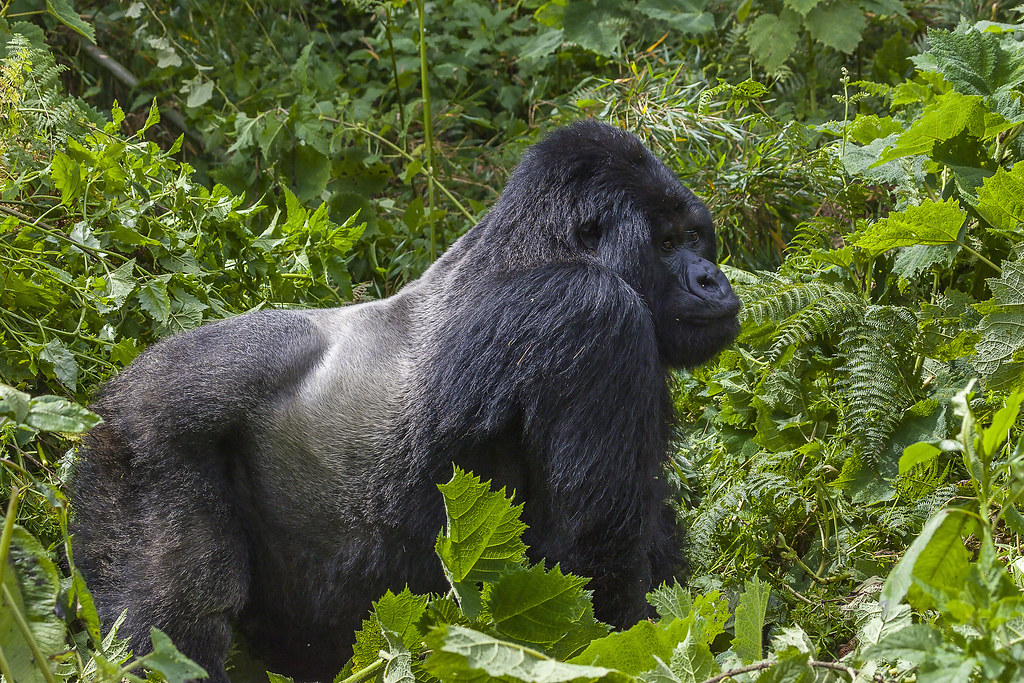
The Democratic Republic of Congo offers the most affordable gorilla permit in the region and some of its most dramatic scenery, centred on Virunga National Park – Africa’s oldest national park and one of the few places on Earth where you can stand at the rim of an active lava lake. It’s also the country in our operating region where an honest security caveat matters most: eastern DRC’s stability can shift, and we always confirm current conditions before booking rather than assuming past availability holds.
Gorilla Trekking in Virunga National Park
Virunga National Park, a UNESCO World Heritage Site established in 1925, hosts several habituated mountain gorilla families on the Congolese side of the Virunga volcanic range – the same mountain chain that extends into Uganda’s Mgahinga and Rwanda’s Volcanoes National Park. Trekking here follows the same fundamental structure as Uganda and Rwanda: a briefing at park headquarters, trackers locating the assigned family, and a strict one-hour viewing window once found. The permit itself costs roughly $400 per person, less than half Uganda’s rate and well under a third of Rwanda’s, making Congo the most budget-accessible of the three countries for the core trekking experience.
Virunga National Park predates both Uganda’s and Rwanda’s gorilla parks by decades, and that history shows in the park’s scale and ambition – alongside gorilla trekking, Virunga offers a genuinely rare overnight hike to Mount Nyiragongo’s active lava lake, one of only a handful in the world large enough to see from the crater rim after dark. We’re direct about the trade-off: Congo’s lower permit cost and dramatic scenery come alongside a security situation that shifts more than Uganda’s or Rwanda’s, and trekking access has been suspended in the past during periods of regional instability in eastern DRC. We check current park operating status and give an honest, up-to-date security advisory before confirming any Congo booking, rather than working from outdated general information. For travellers who’d rather avoid that variable altogether, Uganda and Rwanda offer a more predictable booking experience at a higher permit price.
DR Congo at a Glance
| Gorilla permit | ~$400 per person |
| Main park | Virunga National Park |
| Established | 1925 – Africa’s oldest national park |
| Signature extra | Mount Nyiragongo’s active lava lake |
| Security status | Variable – confirmed at time of booking |
Mount Nyiragongo and Its Lava Lake
Beyond gorilla trekking, Virunga’s other major draw is Mount Nyiragongo, an active stratovolcano holding the largest lava lake on Earth. A guided overnight hike to the crater rim – a genuinely demanding climb rewarded with a view of glowing lava after dark – is one of the more singular adventure experiences available anywhere in the region, and a common add-on for travellers combining it with a Virunga gorilla trek given the park’s dual draw.
Wildlife Beyond Gorillas
Virunga’s ecosystem spans volcanic highlands, savannah and lowland forest, supporting chimpanzees, forest elephants, and okapi – a genuinely unusual striped relative of the giraffe found almost nowhere else on Earth outside DRC’s forests. Kahuzi-Biega National Park, further south, offers trekking to habituated eastern lowland gorillas, a distinct subspecies from the mountain gorillas found in Virunga, Bwindi and Volcanoes National Park, giving DR Congo a primate-trekking variety the other two countries don’t offer.
The Honest Security Picture
Eastern DR Congo has experienced periods of armed conflict and instability, and Virunga National Park has been closed to tourism during some of these periods for genuine safety reasons, most notably for extended stretches over the past decade. This is not a footnote we gloss over: we check Virunga’s current operating status and the latest travel advisories specifically before proposing or confirming any Congo itinerary, and we’ll tell you plainly if conditions mean we can’t responsibly recommend a trip at a given time, rather than booking regardless and hoping for the best.
Getting to Virunga
Most Congo itineraries route through Rwanda, crossing the border at Gisenyi into Goma, the nearest town to Virunga National Park’s headquarters. This means a DR Congo trip typically combines naturally with a Rwanda stay before or after, rather than standing alone, and requires a separate DRC visa arranged in advance – we handle this as part of any Congo-inclusive booking, confirming current requirements at the time rather than relying on general information that may have changed.
Rangers and Conservation Under Difficult Conditions
Virunga’s rangers operate under genuinely difficult and sometimes dangerous circumstances, and the park’s conservation story is inseparable from their commitment – more Virunga rangers have died in the line of duty protecting the park than at almost any other protected area in the world. Trekking permit revenue directly funds ranger salaries, equipment and the broader park protection effort, meaning a Congo gorilla trek supports conservation work happening under real, ongoing pressure in a way that’s worth understanding rather than glossing over.
What a Congo Trip Typically Includes
A representative Congo-inclusive itinerary might combine two nights in Goma or at a Virunga-adjacent lodge for the gorilla trek itself, an optional two-day Nyiragongo hike for travellers wanting the volcano experience, and a Rwanda extension either side – Kigali for arrival and departure, Volcanoes National Park for a second, different gorilla trek, or Lake Kivu for a calmer close to the trip. We build the Rwanda portion first as the reliable backbone of the itinerary, then layer in the Congo segment once current conditions are confirmed, rather than building an itinerary around Congo access that might not hold by the time of travel.
Insurance and Emergency Considerations
Given the additional considerations involved, we recommend comprehensive travel insurance with medical evacuation coverage for any Congo-inclusive trip, ideally one that explicitly covers travel to the specific region rather than a generic policy that may exclude it. We work with an established local operator on the ground in Goma who maintains direct emergency contacts and evacuation arrangements, and we’ll walk through exactly what’s in place before you commit to a Congo segment on your itinerary.
Frequently Asked Questions
Do children have a minimum age for Congo gorilla trekking?
Yes, 15 years old, the same minimum age consistently applied across both Uganda and Rwanda, strictly enforced by Virunga National Park’s own internal rules.
Is it safe to visit DR Congo for gorilla trekking?
It depends on current conditions in the specific area, which can change. We check Virunga’s operating status and current travel advisories before proposing or confirming any Congo itinerary, and we’re direct if conditions don’t support a safe trip at a given time.
Why is Congo’s gorilla permit so much cheaper?
It partly reflects the park’s specific operating context and partly reflects a deliberate pricing decision aimed at keeping trekking genuinely accessible despite the country’s broader tourism development challenges relative to Uganda and Rwanda.
Can I combine Congo with Rwanda on one trip?
Yes – most Congo itineraries route through Rwanda via the Gisenyi/Goma border crossing, making a combined trip the natural structure rather than visiting DR Congo in isolation.
What’s the difference between mountain and lowland gorillas?
Mountain gorillas (found in Virunga, Bwindi and Volcanoes National Park) live at higher altitude with thicker fur; eastern lowland gorillas (found at Kahuzi-Biega) are a larger, distinct subspecies found only in DR Congo’s lower-altitude forests.
Comparing Congo to Uganda and Rwanda
It’s worth being direct about why Congo isn’t simply the obvious choice given its lower permit price. Uganda and Rwanda both offer significantly more developed tourism infrastructure – a wider range of accommodation, more established road networks, and a longer track record of consistent, uninterrupted trekking access. Congo’s appeal is genuine (the price, Nyiragongo, the lowland gorilla option at Kahuzi-Biega) but it comes bundled with real logistical and security considerations that Uganda and Rwanda largely don’t carry. We recommend Congo specifically to travellers who understand and accept those trade-offs, rather than positioning it as a straightforwardly better-value alternative to the other two countries.
Kahuzi-Biega and Eastern Lowland Gorillas
Kahuzi-Biega National Park, south of Virunga near Bukavu, offers a genuinely different primate trekking experience: eastern lowland gorillas, the largest of all gorilla subspecies, found in lower-altitude, denser forest than their mountain gorilla relatives. Trekking here is less commonly combined with a standard Congo itinerary given the added distance and logistics from Virunga, but it’s a real option for travellers specifically interested in seeing both gorilla subspecies within one country, something no other destination in the region offers.
Practical Preparation for a Congo Trip
Beyond the standard trekking kit – sturdy boots, layered clothing, rain protection – a Congo trip benefits from extra flexibility built into the schedule specifically, since border crossing procedures and park access can occasionally involve delays that a Uganda or Rwanda itinerary wouldn’t typically encounter. We build in buffer time around the Congo segment of any combined itinerary for exactly this reason, rather than scheduling it as tightly as the Rwanda or Uganda portions of the same trip.
Currency and Language
The Congolese franc is the official currency, though US dollars are widely accepted and generally preferred for tourism-related payments including any Congo-specific fees. French is the official language, alongside Swahili which is widely spoken in the eastern provinces near Virunga, so English-language communication is somewhat less universal here than in Uganda or Rwanda – another reason we keep an experienced local guide with the group throughout the Congo segment of any itinerary rather than relying on independent travel.
Photography and What to Expect Visually
Virunga’s landscape is genuinely dramatic in a way photographs struggle to fully capture – active volcanic cones, dense equatorial forest, and the specific quality of light at altitude near the crater rim after dark. Bring extra battery capacity and memory cards regardless of trip length, since charging opportunities can be less consistent here than at more established lodges in Uganda or Rwanda, and the Nyiragongo night hike specifically rewards a camera capable of handling low-light conditions well.
Plan Your Congo Trip
Tell us your dates and general interest in a Congo-inclusive itinerary, and we’ll confirm the current Virunga operating status and the latest security conditions directly before proposing anything specific. Get in touch to start planning.