
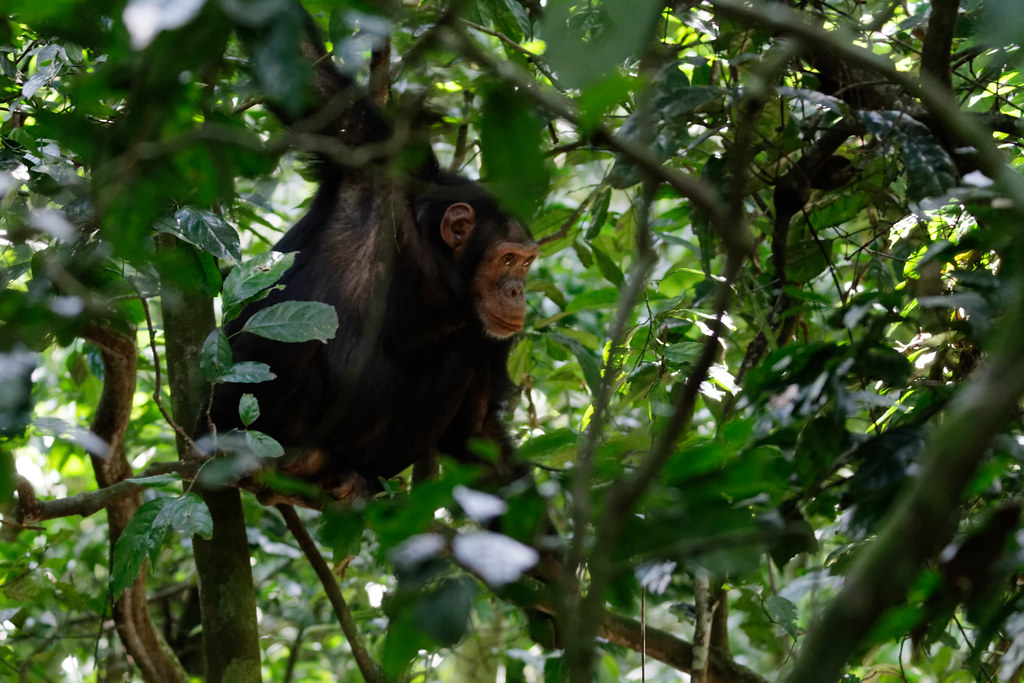
The Chimpanzee Habituation Experience is the longer, considerably more immersive alternative to standard chimpanzee trekking, following a community still being habituated to human presence for up to four hours rather than the standard one. Run in Kibale Forest alongside genuine ongoing research, it’s built specifically for travellers who want real depth with a chimpanzee community rather than settling for a single-hour encounter.
How Habituation Differs From Standard Trekking
A community selected for the habituation process isn’t yet at the fully relaxed, genuinely predictable state of Kibale’s long-established habituated groups used for standard one-hour treks – they’re calmer around people than a genuinely wild community, but the process of adjusting to consistent human presence is still actively underway. Participants join researchers and trackers as part of that ongoing process, spending a full morning-to-afternoon block with the community rather than a fixed hour, and picking up detail on individual identities, family relationships and behavioural patterns that a standard visit simply doesn’t have time to cover.
A Day With the Habituation Experience
The day begins before dawn, meeting the chimpanzees at their overnight nest site as they wake – genuinely one of the most striking parts of the experience, watching a community stir and begin its day from close range. From there, participants follow the group for up to four hours as they move, feed and socialise through the forest, walking a considerably longer and more variable route than a standard trek given how much ground a community covers across a full active period.
Habituation at a Glance
| Location | Kibale Forest National Park, Uganda |
| Duration | Up to 4 hours with the community |
| Permit cost | ~$220 per person |
| Daily group size | Deliberately limited, smaller than standard treks |
| Minimum age | 12 years |
Why the Group Size Is Smaller
Standard chimpanzee treks cap groups at a set number of daily permits per community; the habituation experience runs with fewer people still, since a community still adjusting to human presence needs a calmer, less crowded exposure than a fully habituated group can tolerate. This keeps the experience genuinely intimate, but it also means booking well ahead matters more here than for standard trekking, given how few permits are issued each day.
Who the Experience Suits
The habituation experience suits travellers who’ve already done a standard primate trek and want more depth, researchers and conservation-minded travellers genuinely interested in the process of habituation itself, and anyone simply wanting more time with wild chimpanzees than a single hour allows. It’s a real step up in both cost and physical duration from standard trekking, so it’s worth being honest about whether the additional depth matters enough to you personally to justify the difference, rather than assuming it’s automatically the better choice.
Physical Demands
Four hours of forest walking, often at a faster pace than a standard trek given how much chimpanzee communities move through a full active period, makes this a genuinely more demanding activity than standard trekking. A reasonable baseline fitness level matters more here, and we’re direct about this during planning rather than assuming every traveller wants or can manage the longer format.
The Science Behind Habituation
Habituating a wild primate community to human presence is a slow, deliberate process, typically taking two to three years of consistent, careful daily contact before a community reaches the calm, predictable state needed for regular tourist visits. Researchers and trackers visit the target community every day regardless of tourist bookings, maintaining consistent, non-threatening behaviour until the chimpanzees stop reacting to human presence as a threat. The habituation experience gives visitors a genuine window into this process mid-way through, rather than only ever seeing the finished result of a fully habituated group used for standard treks.
What You’ll Actually See
Because the format runs so much longer than a standard trek, the habituation experience captures a fuller range of chimpanzee behaviour across a single visit: morning waking and grooming at the nest site, foraging and feeding as the community moves through the forest, social interactions between individuals including occasional dominance displays, and often tool use – chimpanzees are known to use sticks to extract termites and stones to crack nuts, genuinely striking evidence of the species’ cognitive complexity. A standard one-hour visit might catch one or two of these behaviours; the extended format makes seeing several within a single visit far more likely.
Comparing Cost: Habituation vs. Standard Trekking
| Standard chimpanzee trek | ~$250 · 1 hour with community |
| Habituation experience | ~$220 · up to 4 hours with community |
| Cost per hour, standard | ~$250/hour |
| Cost per hour, habituation | ~$55/hour |
Interestingly, the habituation experience’s permit costs slightly less than a standard trek despite running considerably longer, making it genuinely strong value on a straightforward cost-per-hour basis for travellers prepared for the greater physical duration and the somewhat less predictable behaviour of a community still adjusting to human presence.
Booking and Availability
Because daily permits are deliberately limited to keep the experience calm for the community itself, habituation permits sell out faster relative to their small daily allocation than standard trekking permits do. We recommend confirming a habituation booking as early as possible once your dates are set, ideally alongside or before securing any other permits on the same itinerary, given how tight this particular allocation tends to run during peak season specifically.
Health and Conservation Guidelines
Because a community still being habituated is more vulnerable to human-transmitted illness than a fully settled group, health screening before the day begins is taken particularly seriously – anyone showing signs of a cold, flu or other communicable illness will be asked not to join. A minimum viewing distance is strictly maintained throughout the entire visit, and flash photography is firmly prohibited, the same core protections that apply to standard trekking too, but arguably even more important here given the community’s earlier stage of habituation and correspondingly greater sensitivity to disturbance.
Is It Worth the Extra Time and Effort?
Honestly, this depends entirely on what you’re after. Travellers who found a standard one-hour trek genuinely too short, or who have a specific research or conservation interest in primate behaviour, tend to come away feeling the habituation experience was clearly worth the extra duration and cost. Travellers primarily wanting a memorable but time-efficient wildlife encounter, or with a tighter overall itinerary, are often just as satisfied with standard trekking. We’re happy to talk through which format genuinely fits your priorities rather than assuming the longer, more involved option is automatically the better one for every traveller.
Frequently Asked Questions
Is the habituation experience better than standard trekking?
Not objectively better – it’s a genuine trade-off between depth and physical/cost commitment. Some travellers strongly prefer the shorter, guaranteed-format standard trek; others value the extended access enough to justify the difference.
How far in advance should I book?
Further ahead than standard trekking given the smaller daily permit allocation – we recommend confirming as early as possible once your dates are set.
Can I do habituation and standard trekking on the same trip?
Yes, though we’d generally space them across different days given the physical demand of each, rather than scheduling them back to back.
Is gorilla habituation also available?
Yes – a parallel experience runs for gorillas in Bwindi’s Rushaga sector, following the same longer-format logic for a gorilla community rather than chimpanzees.
What to Bring
Given the longer duration, packing for the habituation experience deserves a bit more thought than a standard hour-long trek. Beyond the usual sturdy boots, long trousers and rain jacket, we recommend bringing more food and water than you’d carry for a standard trek – a proper packed breakfast and lunch, since the day genuinely spans a full morning into afternoon rather than a couple of hours. A dry bag or waterproof cover for cameras and electronics is worth having too, given how much longer you’re exposed to whatever the forest weather does that day.
Guides and Researchers on the Day
Because the habituation experience runs alongside genuine ongoing research, the guiding team on the day typically includes both a standard park ranger guide and researchers or trackers directly involved in the community’s habituation process. This adds a level of expertise and detail to the day that a standard trek’s single guide can’t always match – questions about individual chimpanzee identities, family relationships, and the specific behavioural milestones the habituation process is tracking tend to get considerably more detailed answers here than on a shorter standard visit.
Combining With Other Kibale Activities
The habituation experience pairs naturally with a stop at nearby Bigodi Wetland Sanctuary on a different day of the same trip, or with a standard chimpanzee trek elsewhere in the region for travellers wanting to compare both formats directly. Given how much of a full day the habituation experience itself takes, we generally don’t recommend stacking another major activity on the same day – it works best as the single focus of whichever day it’s scheduled on.
Book the Chimpanzee Habituation Experience
Tell us your dates and we’ll check current availability directly with the park, given just how limited daily permits genuinely are for this specific, smaller-scale experience. Get in touch to start planning.