
A Partnership Hidden in Plain Sight
One of the most surprising things about an African safari is discovering how many animals rely on one another.
Visitors often expect to see predators hunting prey, but some of the most fascinating relationships involve cooperation rather than conflict. Across the grasslands of East Africa, one partnership appears so frequently that many travellers barely notice it.
Zebras and wildebeest.
Whether in Uganda’s savannah parks, Kenya’s Maasai Mara, or Tanzania’s Serengeti, these two species are often found grazing side by side. At first glance, it seems like a coincidence. After spending time observing them, however, it becomes clear that their relationship is anything but accidental.
A Morning on the Plains
The sun had just begun warming the savannah when we spotted them.
A large group of wildebeest stretched across the grassland, their dark bodies moving steadily as they grazed. Mixed among them were dozens of zebras, their striking black and white stripes standing out against the golden landscape.
The two species appeared completely comfortable in each other’s company.
There were no signs of competition or conflict. Instead, they moved together as though they belonged to the same herd.
Our guide smiled and explained that what we were witnessing was one of Africa’s most successful wildlife partnerships.
Different Diets, Same Grassland
One reason zebras and wildebeest work so well together is that they do not eat grass in exactly the same way.
Zebras are often the first to feed on taller, coarser grasses. Their strong teeth and digestive systems allow them to process vegetation that many other grazers avoid.
As zebras crop the longer grass, they expose the shorter, fresher shoots underneath.
This creates ideal feeding conditions for wildebeest, which prefer shorter and more nutritious grass.
Rather than competing for food, the two species actually improve grazing conditions for one another.
Two Species, Two Sets of Strengths
The partnership extends beyond feeding habits.
Zebras and wildebeest each possess strengths that help protect the entire group.
Zebras have excellent eyesight. They can often spot movement across long distances and quickly detect potential danger on open plains.
Wildebeest, on the other hand, have a highly developed sense of smell and excellent hearing. They can often detect predators hidden in grass long before they become visible.
When these abilities are combined, both species gain an advantage.
A predator approaching the herd has a much harder time remaining undetected.
The Constant Threat of Predators
Life on the savannah is never completely safe.
Lions, spotted hyenas, leopards, cheetahs, and African wild dogs all hunt grazing animals. Detecting danger early can mean the difference between life and death.
As we watched the mixed herd, several zebras suddenly lifted their heads.
Within moments, nearby wildebeest did the same.
Nothing appeared to be wrong, but the reaction spread quickly through the group. Every animal became alert.
A few minutes later, a distant lioness emerged from behind a cluster of bushes.
The herd had detected her long before we did.
Safety in Numbers
The sheer size of these mixed gatherings provides another important advantage.
Predators often target isolated individuals because attacking a large group carries greater risk and requires more effort. By remaining together, zebras and wildebeest reduce the likelihood of becoming easy targets.
More animals also mean more eyes, ears, and noses monitoring the environment.
This collective awareness creates an effective defence system that benefits every member of the herd.
The Great Migration Connection
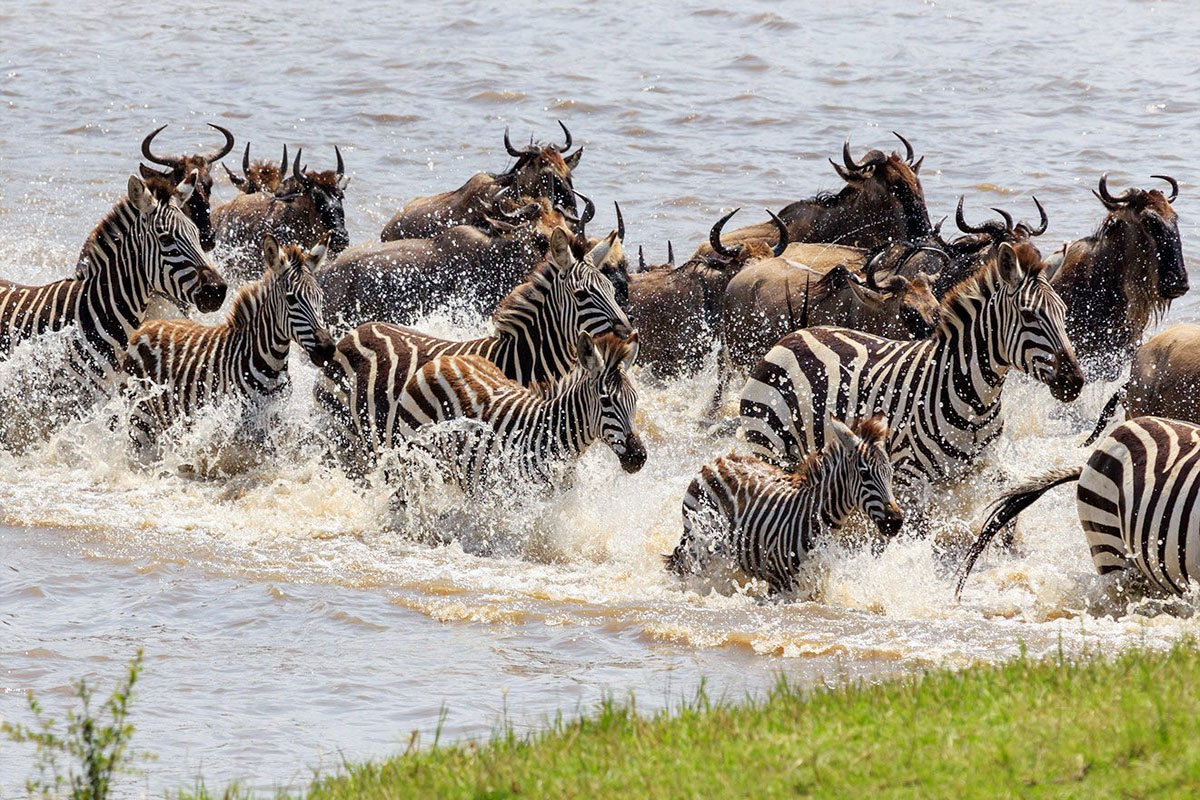
Nowhere is this alliance more visible than during the Great Migration.
Each year, more than a million wildebeest travel across the Serengeti and Maasai Mara ecosystems in search of fresh grazing after seasonal rains. Accompanying them are hundreds of thousands of zebras.
The migration covers vast distances and includes dangerous river crossings, encounters with predators, and long journeys through changing landscapes.
Throughout it all, zebras and wildebeest remain closely associated.
Their partnership helps them locate food, detect danger, and navigate one of the most challenging wildlife journeys on Earth.
Communication Across Species
One remarkable aspect of this relationship is how effectively different species respond to one another.
When zebras become nervous, wildebeest pay attention.
When wildebeest suddenly change direction or begin moving quickly, zebras often react as well.
Although they do not communicate in the same way members of a single species do, both animals have learned to recognise behavioural signals that indicate danger.
Over countless generations, this awareness has strengthened their ability to survive together.
A Waterhole Gathering
Later that afternoon, we encountered the same partnership at a waterhole.
Zebras approached from one direction while wildebeest arrived from another. Within minutes, the two groups merged into a larger gathering.
The scene demonstrated another advantage of their alliance.
Waterholes attract predators as well as prey. By arriving in larger mixed groups, both species reduce their vulnerability while drinking.
Several animals remained alert while others lowered their heads to the water.
The responsibility of watching for danger was shared.
Where to Observe This Alliance
Travellers can witness this relationship throughout East Africa.
In Tanzania, Serengeti National Park offers some of the best opportunities to observe zebras and wildebeest grazing together, particularly during migration periods.
Kenya’s Maasai Mara National Reserve provides similar experiences, especially when migrating herds move north from the Serengeti.
In Uganda, visitors may occasionally observe mixed grazing groups in areas where both species occur, particularly within larger savannah ecosystems.
The exact size of the gatherings varies, but the partnership remains remarkably consistent wherever the two species share the same landscape.
More Than Coincidence
Watching zebras and wildebeest together changes how many people view the African wilderness.
At first, they appear to be two unrelated species simply sharing the same habitat. Closer observation reveals something much more interesting.
Each species benefits from the other’s presence.
Zebras prepare grazing areas.
Wildebeest contribute additional predator detection.
Both gain protection through larger numbers.
Together, they create a partnership that has endured for thousands of years.
The Unlikely Alliance
As the sun began setting over the plains, the mixed herd continued feeding peacefully.
From a distance, the zebras and wildebeest appeared to move as one community. They grazed together, watched for danger together, and travelled together across the landscape.
The relationship may seem unlikely when viewed through human eyes. One animal wears bold black and white stripes, while the other looks rugged and almost prehistoric.
Yet survival on the African savannah is not about appearances.
It is about recognising strengths, adapting to challenges, and taking advantage of opportunities that improve the odds of survival.
The alliance between zebras and wildebeest does exactly that. It is one of the most successful partnerships in the natural world and one that safari travellers can witness every day across the great grasslands of East Africa.