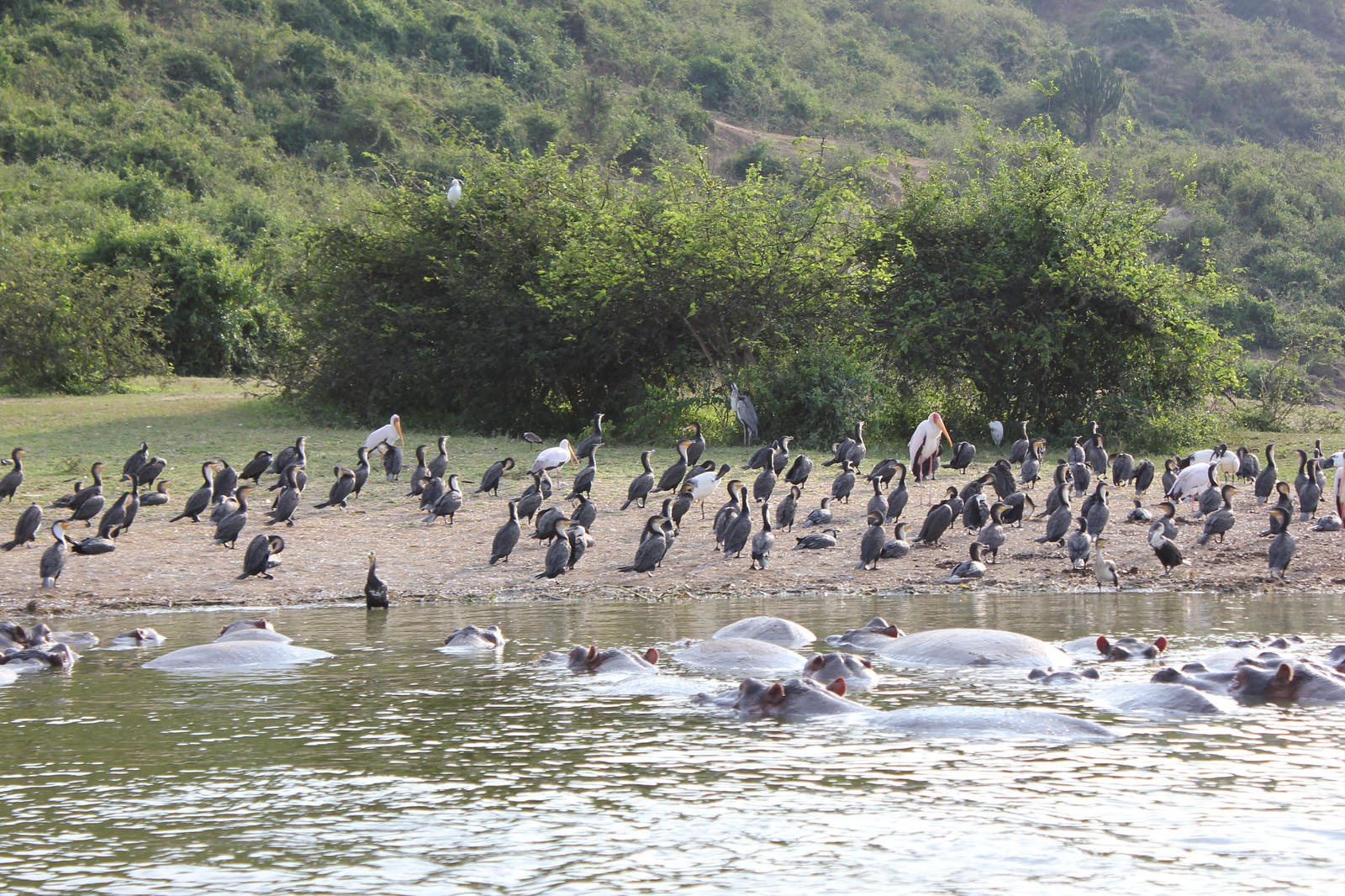
Kazinga Channel Boat Safari: Uganda’s Best Wildlife Cruise
The first thing you notice isn’t the animals.It’s the smell.Not a bad smell, exactly. Just… alive. Wet earth. Fish. Hippo dung. The thick, humid breath of a waterway that’s been here for thousands of years, carrying animals and boats and who knows what else.You climb onto the boat. Find a seat. Adjust your camera. Look around at the other tourists — excited, nervous, slathered in sunscreen.Then the engine starts. The boat pulls away from the dock.
And within five minutes, you forget about everything except what’s in front of you.I’ve done this cruise three times now. Three times, on different trips, in different seasons, with different guides.Every single time, I’ve seen something that made me say “wow” out loud.Not because I’m easily impressed. Because the Kazinga Channel is genuinely ridiculous.
Wait, What Exactly Is the Kazinga Channel?
Good question.Most people hear “channel” and think of something small. A creek. A drainage ditch.The Kazinga Channel is not that.It’s about 40 kilometers long. Connects two massive lakes — Lake Edward and Lake George. In some places, it’s as wide as a small river.And it’s packed with wildlife.I mean packed.
Hippos by the hundred. Crocodiles lounging on every sandbank. Elephants coming down to drink. Buffalo wading up to their bellies. Birds everywhere — kingfishers, fish eagles, herons, storks, things I couldn’t even name.The channel acts like a magnet. During dry season, the surrounding savanna is parched. But the channel? Always there. Always wet. Always attracting animals from miles around.That’s why the boat cruise works so well.You’re not searching. You’re just… floating. And the animals come to you.
The Hippos (Lots of Them. Really Lots.)
Let me be honest about hippos.Before I saw them in the wild, I thought they were kind of goofy. Chubby. Cute, in a weird way. Those cartoon hippos dancing in tutus? That was my mental image.The Kazinga Channel fixed that.Hippos are not cute. They’re terrifying. In the best possible way.
You see them in the water first. Just eyes and nostrils poking above the surface. They look small from a distance. Then your boat gets closer. And closer. And you realize how massive they actually are.
A full-grown hippo weighs over 3,000 pounds. That’s more than a small car. And they’re fast. Faster than you on land. Faster than you in water.But here’s what you actually see on the cruise.
Hundreds of hippos, packed into the channel like commuters on a train. They snort. They yawn — showing those ridiculous canine teeth, which are about a foot long. They spray water everywhere. They grunt at each other. Sometimes they fight, crashing into each other with a sound like boulders colliding.
One guide told me that the Kazinga has one of the highest concentrations of hippos in Africa.I believe him.But the thing I remember most? Not the numbers. Not the size.
It was the sound.We cut the engine and just drifted. The hippos were maybe twenty meters away. And the noise they made — a chorus of grunts, snorts, wheezes — was so loud and so strange that I started laughing. Couldn’t help it.The guide smiled. “They’re talking,” he said.I have no idea what they were saying. But it felt like they knew we were listening.
The Crocodiles (And Why You Should Respect Them)
The Nile crocodiles in the Kazinga Channel are not subtle.They lie on the sandbanks. Mouths open. Eyes half-closed. Looking like dinosaurs that forgot to go extinct.And they’re big. Not like zoo crocodiles. Like, “that thing could eat a small antelope in one bite” big.The first time I saw one, it was completely still. I thought it was a log. A very long, very scaly log.Then it blinked.
Our boat drifted closer — not too close, the guide knew what he was doing — and the crocodile didn’t move. Didn’t flinch. Just watched us with those cold eyes.I asked the guide if crocodiles ever attack boats.“Small boats,” he said. “Canoes. Fishing boats. Tour boats? No. Too big. They’re not stupid.”
That was reassuring. Sort of.But he also told me that crocodiles can launch themselves out of the water faster than you can react. That they can hold their breath for over an hour. That they’ve been around for millions of years, unchanged, because they’re basically perfect at what they do.I stopped thinking of them as logs after that.
The Elephants (Coming Down for a Drink)
You’ll see elephants on game drives in Queen Elizabeth.But seeing them from the water is different.On land, elephants are alert. Listening. Watching. They know predators can approach from anywhere.At the water’s edge, they relax.
You’ll see a herd approach the channel slowly. The matriarch first. She checks the bank. Listens for danger. Then she leads the family down.
The babies go first. Wading into the shallow water. Splashing themselves with their trunks. The mothers follow, keeping close.And here’s something you might not expect.Elephants swim.
Not just wade. Swim. Their bodies disappear under the muddy water. Their trunks become snorkels, sticking up like periscopes. Then a massive head surfaces, snorts water into the air, and goes back under.I watched a young bull swim across the entire channel once. Took him maybe five minutes. He climbed out on the other side, shook himself off, and walked away like it was nothing.For him, it probably was.
The Birds (Even If You’re Not a Bird Person)
I’m not a bird person.
I mean, I like birds. They’re fine. But I’ve never owned binoculars specifically for birdwatching. Never kept a life list.The Kazinga Channel almost made me become one.There are over 600 bird species recorded in Queen Elizabeth National Park. And a huge number of them hang out around the channel.
You’ll see:
African fish eagles. They look like American bald eagles, but with a chestnut chest. They sit in dead trees overlooking the water, then dive down to snatch fish with their talons. The sound they make — that wild, echoing cry — is the soundtrack of the channel.
Kingfishers. Tiny. Electric blue. They hover over the water like helicopters, then plunge in headfirst. I saw one catch a fish, smash it against a branch to kill it, and swallow it whole. Took maybe three seconds.
Saddle-billed storks. Huge. Dramatic. Black and white with a bright yellow and red beak. They look like they’re dressed for a formal event.
Goliath herons. The largest heron in the world. They stand completely still for minutes at a time, then strike at fish with a beak the size of a knife.
Pink-backed pelicans. They float in groups, herding fish into shallow water. Watching them work together is strangely hypnotic.
My guide pointed out a bird called the “shoebill” once. Extremely rare. Looks like a dinosaur. I didn’t see it — it was hiding in the reeds — but the guide got excited just talking about it. “You’re lucky if you see one,” he said. “Some people come here just for that bird.”I believe him. Bird people are dedicated.
When to Go (Morning vs. Afternoon vs. Sunset)
I’ve done all three. Here’s the honest breakdown.
Morning cruise (8:00 AM or 9:00 AM). The air is cool. The light is soft. Animals are active after the night. You’ll see plenty. But the photos won’t be as dramatic as later in the day. And the early morning mist can make things hazy.
Afternoon cruise (12:00 PM or 1:00 PM). Honestly? Skip it. The sun is high. The light is harsh. Animals are sleeping. The hippos are mostly submerged. You’ll still see things, but it’s the least magical option.
Late afternoon cruise (3:00 PM or 4:00 PM). This is the sweet spot. The light starts turning golden. Animals wake up and start moving again. Elephants come to drink. Birds start hunting. The shadows get longer. Everything looks better.
Sunset cruise (5:00 PM or later, depending on season). This one is for the experience, not the wildlife viewing. The animals are still active, sure. But the real draw is the sky. The sun sets behind the Rwenzori Mountains. The channel turns orange and pink and purple. Hippos grunt in the fading light. It’s beautiful. Romantic, even. But you’ll see fewer animals than the late afternoon cruise because it gets dark quickly.
My recommendation? Book the 4:00 PM cruise. Bring a jacket — it gets cool on the water. Stay until the end. You’ll get the best wildlife viewing and the sunset.
Which Boat to Take (The Two Options)
There are two boat operators on the channel.
Uganda Wildlife Authority (UWA) boat. The standard option. Big boat. Holds maybe 50 people. Covered roof for shade. Licensed guide provided. This is what most tourists take. It’s perfectly fine. Reliable. Safe. The guides are knowledgeable.
Mweya Safari Lodge private boat. Smaller boat. Holds maybe 10 people. No roof. More expensive. You can book it even if you’re not staying at the lodge (but guests get priority). The experience is more intimate. You can ask the guide to stop or turn around if you see something interesting. The UWA boat tends to keep moving on a schedule. Which one should you take? If you’re on a budget: UWA boat. It’s totally fine. You’ll see the same animals.If you want a more personal experience: spring for the private boat. I did it once as a splurge. Worth it. We spent an extra fifteen minutes watching a family of elephants swim across the channel. The UWA boat had already moved on.
What Nobody Tells You Before You Go
Bring a jacket. I’m serious. Even in the middle of the day, the wind on the water can be chilly. By sunset, you’ll be cold. I learned this the hard way. Shivered through the entire last hour.
Sunscreen is not optional. The sun reflects off the water. You’ll burn faster than you expect. I saw a man who looked like a lobster by the end of the cruise. He was miserable.
Binoculars matter. The boat can’t get too close to hippos and crocodiles. (Safety reasons.) Binoculars bring the animals to you. Don’t forget them.
Your camera needs a fast shutter. Animals move. Birds fly. Hippos splash. If your camera is slow, you’ll get blurry photos. Use a fast shutter speed. Or just put the camera down and watch. Honestly, that’s what I do now.
There’s a toilet on the UWA boat. Not a nice one. But it’s there. Use it before you go if you can.
You might get splashed. Not by waves. By hippos. They surface suddenly. They spray water everywhere. I’ve seen people get soaked. Keep your camera in a dry bag.
The One Moment I’ll Never Forget
I’ve saved this for the end.On my second cruise, late afternoon, the boat was quiet. Everyone was tired. The guide had stopped talking. We were just drifting.Then he cut the engine completely.“Listen,” he whispered.Silence.
Then, from somewhere along the bank, a sound. A deep, guttural cough. Then another. Then a splash.The guide pointed.A hippo had climbed out of the channel. It was standing on the bank, maybe fifty meters away. Huge. Muddy. Looking straight at us.
Then it opened its mouth. That impossible gape. A foot-long teeth.And it made a sound I’d never heard before. Not a grunt. Not a snort. Something between a roar and a bellow. Loud enough to feel in my chest.The guide smiled.
“He’s saying good evening,” he said.The hippo turned, walked back into the water, and disappeared.I’ve never felt smaller. Or more alive.
Practical Info (So You Can Actually Go)
How to book. You can book at the Mweya Peninsula dock. Or through your lodge. Or through a tour operator. Advance booking isn’t usually necessary outside peak season. But if you’re visiting in June-August or December-February, book a day ahead.
How much it costs. UWA boat: around $30 per person. Private boat: $50–80 depending on group size. Permits not included in park entrance fees.
How long it takes. The standard cruise is 2 hours. Private boats can be shorter or longer by arrangement.
When to arrive. At least 30 minutes early. The dock gets crowded. Good seats go fast. The left side of the boat (facing forward) gets better afternoon light. The right side is better in the morning.
What to bring. Jacket. Sunscreen. Hat. Sunglasses. Binoculars. Camera with fast shutter. Water. Snacks (no glass bottles). A sense of humor (hippos will snort at you. laugh with them).
The Honest One
You could skip the Kazinga boat cruise.
You could just do game drives in Queen Elizabeth. See the lions. See the elephants. See the buffalo. Go home happy.
But you’d be missing something.Game drives are about searching. Scanning the horizon. Driving for hours, hoping for a sighting.
The boat cruise is different.You’re not searching. You’re just… there. Floating. And the animals are all around you. Hippos snorting. Crocodiles watching. Elephants swimming. Birds diving.
There’s no rush. No pressure. No “did we miss it?”Just two hours on the water, surrounded by more wildlife than you’ve ever seen in one place.I’ve done this cruise three times. I’ll do it again.
Not because I need better photos. Because I need that feeling again. The one where you forget about everything except the grunt of a hippo and the cry of a fish eagle and the splash of an elephant sliding into the water.That feeling is why you come to Africa.The boat cruise just delivers it faster than anything else.