
Rwanda’s Twin Lakes: Bulera and Ruhondo Scenic Guide
Just north of Musanze, the town most travellers pass through on their way to gorilla trekking in Volcanoes National Park, a pair of lakes sits quietly separated by little more than a narrow strip of land. Lake Burera and Lake Ruhondo, together known as Rwanda’s twin lakes, rarely make it onto a first-time visitor’s itinerary, overshadowed entirely by the gorillas and volcanoes that draw people to this corner of the country. For travellers who do make time for them, though, the twin lakes offer a genuinely different, quieter side of the Virunga landscape.
A Shared Volcanic Origin
Both lakes owe their existence to the same violent geological event, an eruption of Mount Sabyinyo that sent lava flowing across the landscape and blocked the course of the Nyabarongo River. The trapped water pooled into what eventually became two distinct lakes, separated from one another by a strip of land only about a kilometre wide, close enough that they are almost always discussed and marketed together as a single scenic destination rather than two independent lakes. This shared origin is part of what makes the pairing so visually coherent when viewed from the surrounding hillsides, two large bodies of water sitting side by side against the same dramatic volcanic backdrop.
Burera and Ruhondo: Two Distinct Characters
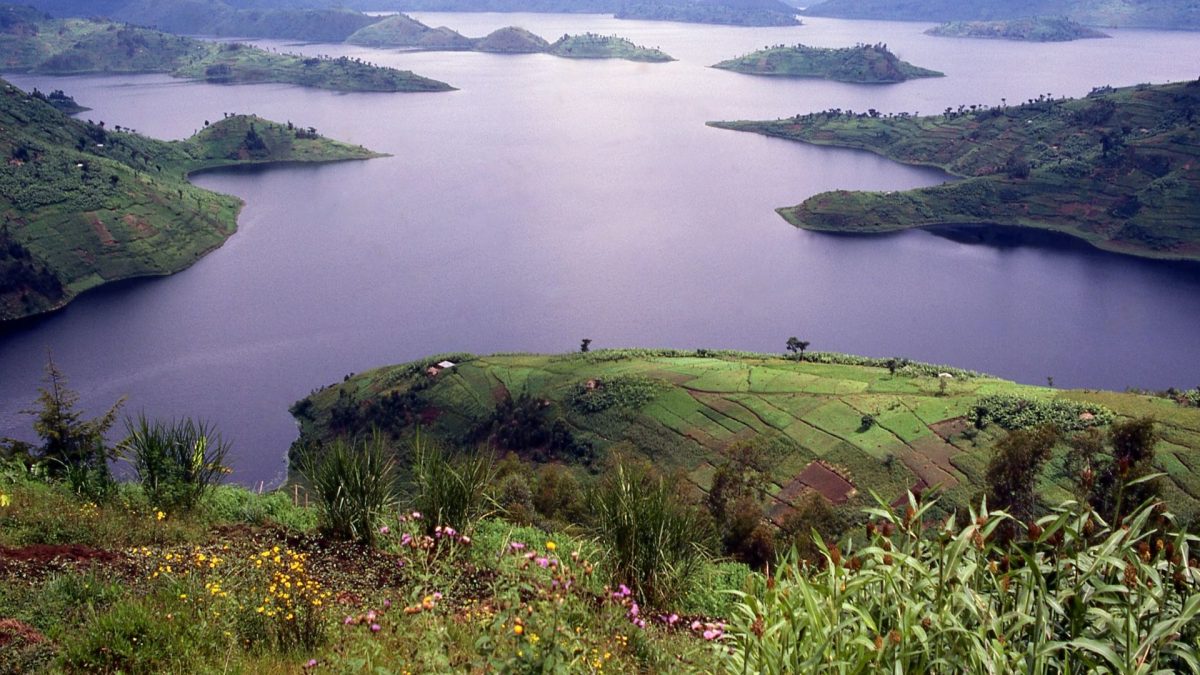
Lake Burera sits at a somewhat higher elevation than its neighbour, and its water is generally understood to feed into Lake Ruhondo below, giving the pairing a subtle sense of connection beyond simple proximity. Burera tends to be the larger and more open of the two, with a landscape of terraced hillsides descending toward its shore that mirrors the agricultural terracing found across much of Rwanda’s densely cultivated countryside. Ruhondo, by contrast, carries a slightly more intimate, enclosed feel, its shoreline framed more tightly by surrounding hills and volcanic terrain.
Both lakes are reputed locally to reach considerable depths, with some estimates placing them among the deeper lakes in the region, though exact figures vary between sources and should be treated as approximate rather than precisely established. What is not in question is the striking visual impact of the setting, still water framed by Rwanda’s characteristic green, terraced hills and, on clear days, distant views of the Virunga volcanoes rising beyond.
Islands Worth Exploring
Scattered across both lakes are several small islands, reachable by boat and offering a worthwhile destination for visitors looking to extend a simple lakeside stop into a more active outing. Names commonly associated with the area’s islands include Muhabura, Bushongo, and Bishosho, among others, each with its own local significance, though formal facilities and infrastructure on most of these islands remain minimal, keeping the experience genuinely low-key and unpolished compared to more developed lake destinations elsewhere in Rwanda.
Boat Trips and Activities
A boat trip across either lake, or between the two via the narrow channel connecting them, ranks as the primary activity for visitors making the journey out to this area. Traditional and motorised boats are both available depending on the specific operator, and a calm morning crossing offers some of the clearest views of the surrounding volcanic peaks, before afternoon cloud typically builds and softens the more distant scenery. Fishing communities along both shores add a working, lived-in texture to the landscape, distinct from the more purely scenic character of some of Rwanda’s other lake destinations.
Why the Twin Lakes Remain Under the Radar
Rwanda’s tourism industry is built overwhelmingly around gorilla trekking, and with permits commanding significant prices and demanding advance booking, most travellers structure their entire Rwanda itinerary around securing and using that single permit efficiently. This understandable focus means secondary attractions near Musanze, including the twin lakes, receive a fraction of the promotional attention and visitor traffic that flows toward the park itself, despite sitting just a short distance from where most gorilla trekking visitors are already staying.
For travellers with even a single spare half-day around a Volcanoes National Park stay, the twin lakes offer a low-cost, low-effort way to see a genuinely different side of the region, without requiring the kind of dedicated day-long commitment that a volcano hike or a longer excursion elsewhere in the country would demand.
Getting There
The twin lakes sit within easy reach of Musanze by road, making them a straightforward half-day addition for travellers already based in the town before or after gorilla trekking. Most visitors arrange transport and any boat activities through their lodge or a local operator familiar with the specific access points and boat operators working the lakes, given the relatively undeveloped state of formal tourism infrastructure in the immediate area compared to the more heavily visited sections of Volcanoes National Park itself.
Photography and Scenic Value
The twin lakes reward photographers willing to make the modest effort of getting out to the shoreline, particularly in early morning light when the water tends to be calmest and the surrounding volcanic peaks, on clear days, are most likely to be visible without obscuring cloud. Terraced hillsides descending toward the water on multiple sides of both lakes add a layered, textured quality to photographs that captures a distinctly Rwandan agricultural landscape alongside the natural drama of the lakes themselves.
A Worthwhile Addition for Travellers With Time to Spare
Rwanda’s twin lakes will never compete with gorilla trekking as a headline attraction, and most visitors will understandably prioritise the park’s primate trekking and volcano hiking options within a limited stay. But for travellers with a spare half-day around Musanze, whether recovering from a demanding trek or simply looking for a quieter, more scenic pace before moving on, Lake Burera and Lake Ruhondo offer a genuinely rewarding, low-key stop, a side of the Virunga landscape shaped by water rather than forest or volcanic peaks, and one that few visitors take the time to properly appreciate.
The Meaning Behind “Twin Lakes”
The pairing of Burera and Ruhondo as Rwanda’s twin lakes reflects more than simple geographic proximity, it captures a genuine sense of the two bodies of water as a linked pair, formed by the same volcanic event and connected by the narrow channel and land strip separating them. Local naming conventions and the region’s own cultural framing of the lakes reinforce this sense of connection, treating Burera and Ruhondo less as two separate destinations and more as complementary halves of a single, unified scenic area, an approach reflected in how most tour operators and guides present the lakes to visitors today.
Fishing Communities and Local Life
Communities living along both lakeshores depend heavily on fishing for their livelihoods, and the daily rhythm of boats departing and returning, nets being prepared and mended, gives the area a genuinely lived-in character quite different from more purely scenic or recreational lake destinations. Visitors curious about this side of the region can often arrange informal interactions with local fishing communities through their guide or boat operator, offering insight into a way of life shaped directly by the lakes rather than by the tourism industry that has grown up around Volcanoes National Park nearby.
Agricultural Terracing Around the Shoreline
One of the more visually distinctive features of the twin lakes area is the extensive agricultural terracing covering the surrounding hillsides, a landscape management technique widely used across Rwanda’s densely populated, hilly countryside to maximise cultivable land on otherwise steep terrain. Descending in stepped patterns toward the water’s edge on both lakes, these terraces add a distinctly human, cultivated dimension to what might otherwise read as purely natural scenery, a visual signature of Rwanda’s broader relationship between dense population, limited flat land, and centuries of adapted agricultural practice.
Combining the Twin Lakes With a Volcanoes National Park Stay
Given their proximity to Musanze, the twin lakes work best as a complementary half-day activity built into a broader Volcanoes National Park itinerary rather than a standalone destination requiring dedicated travel time. Many visitors schedule a lake visit for a rest day between more demanding activities such as gorilla trekking and a volcano hike, using the relatively low-effort boat trip and scenic shoreline as a genuine change of pace rather than another physically taxing excursion layered onto an already active stay.
Seasonal Considerations
Like much of Rwanda’s volcanic highlands, the twin lakes area experiences a fairly consistent climate pattern shaped by altitude, with cooler temperatures than lower-lying parts of the country and a genuine possibility of rain across most months of the year. Morning visits tend to offer the calmest water and clearest views, before afternoon cloud typically builds across the surrounding volcanic peaks, a pattern consistent enough that most local operators default to scheduling boat trips and lake visits earlier in the day wherever a visitor’s broader itinerary allows for that flexibility.
A Quiet Complement to Rwanda’s Bigger Attractions
Rwanda’s twin lakes will likely never draw the crowds or commercial development seen around the country’s gorilla trekking infrastructure, and that relative obscurity is, for many visitors, precisely the point. A morning spent on the calm water of Lake Burera or Lake Ruhondo, surrounded by terraced hillsides and distant volcanic peaks, offers a genuinely different register of experience from the adrenaline and anticipation of a gorilla trek, a reminder that some of Rwanda’s most rewarding stops are the ones that require nothing more than a spare morning and a willingness to look beyond the headline attractions. For travellers already planning a stay near Volcanoes National Park, the twin lakes are well worth the short trip out from Musanze.