
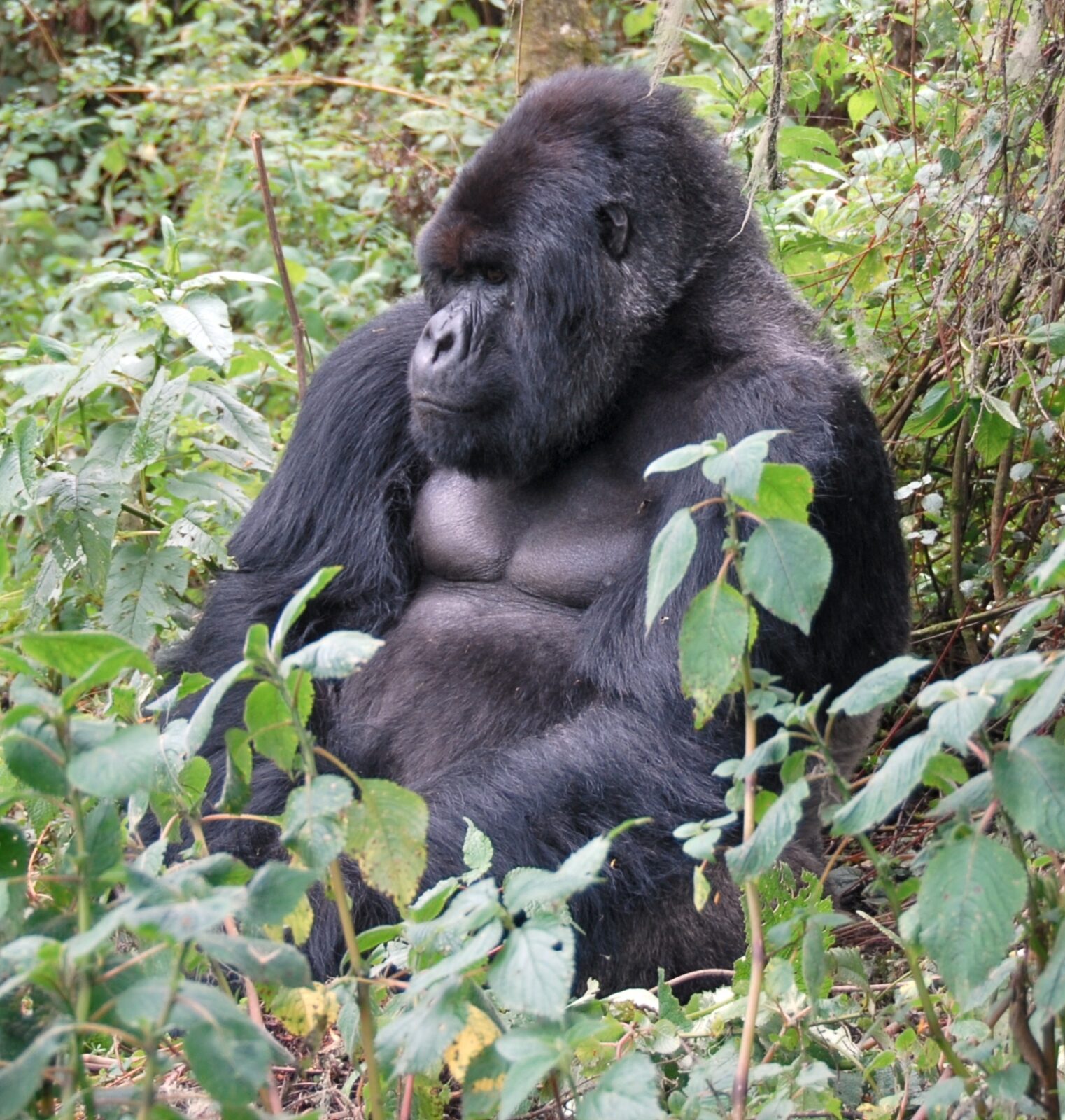
Nobody warns you about the smell before your first gorilla trek, which is strange given how vivid a part of the memory it becomes. What does a gorilla smell like is a question first-timers rarely think to ask beforehand and almost always mention afterward, because it turns out to be one of the more distinctive, unexpected sensations of the entire encounter.
The Short Answer: Musky, Earthy, and Unmistakable
Trekkers consistently describe it as a strong, musky, faintly sweet-sour scent, somewhere between wet fur, damp earth, and something harder to pin down that’s genuinely unique to the species. It’s not unpleasant exactly, but it is powerful, and it tends to arrive before you can even see the family clearly through the vegetation – your nose often registers a gorilla family’s presence in the forest a few moments before your eyes do.
Why Gorillas Smell the Way They Do
It’s worth understanding that this isn’t an incidental byproduct of gorilla biology – scent serves genuine functional purposes within gorilla social life, much as it does for many mammals that rely on it more heavily than humans typically do. Where we lead with vision as our dominant sense, gorillas, like most great apes, draw on a fuller sensory range in which smell carries real informational weight about identity, status, and emotional state within the group.
Several things combine to produce that distinctive scent. Gorillas have scent glands, most notably concentrated around the armpits, that release a musky odour used partly for communication within the family group. Their diet, almost entirely plant-based and heavy on fibrous vegetation, contributes its own earthy undertone. And, like any large mammal living entirely outdoors in a humid rainforest, a certain amount of the smell is simply damp fur and skin, the same base note you’d notice on a wet dog, scaled up considerably in both size and intensity.
The Silverback’s Distinct Odour
Guides who spend years working the same sector, encountering the same handful of habituated families repeatedly, sometimes describe being able to distinguish individual silverbacks partly by scent alone, a skill that takes considerable time in the field to develop and that most visitors never come close to acquiring in a single trek.
Dominant silverbacks tend to carry a noticeably stronger scent than the rest of the family, particularly during moments of tension, display, or when reasserting dominance within the group. This isn’t incidental – the scent functions as a genuine communication signal, broadcasting size, health, and status to both rival males and the family’s own females and offspring, in much the same way visual and vocal displays do. Trekkers who encounter an active, displaying silverback often notice the scent intensify noticeably in that moment, a detail that adds a layer of sensory realism most people don’t expect from a wildlife encounter.
How Smell Changes With Weather and Activity
Time of day plays a role too, in a more subtle way – treks that reach a family early in the morning, before much movement or feeding activity has taken place, sometimes report a milder initial impression than encounters later in the day once the family has been active for hours.
Rain, unsurprisingly common in Bwindi and the Virungas, tends to concentrate the scent rather than wash it away, since damp fur and damp forest floor amplify rather than dilute the smell in the enclosed, humid environment of the forest canopy. Physical exertion changes it too – a family that’s just travelled some distance or engaged in vigorous play or a dominance display tends to carry a stronger scent than one resting quietly, feeding at a relaxed pace.
What Trekkers Actually Report Noticing
Reactions vary more than you might expect. Some trekkers find the scent barely registers once the visual spectacle of the encounter takes over their attention entirely; others describe it as genuinely overwhelming for the first few minutes before their senses adjust and it fades into the background of the experience. Neither reaction is more correct than the other – individual sensitivity to scent varies naturally from person to person, the same way it does with any strong smell encountered for the first time.
Ask enough returning trekkers and a pattern emerges: most describe the smell as one of the most surprising, visceral parts of the encounter, precisely because nothing in the promotional photography or pre-trip briefing prepares you for it. Sight and sound get most of the advance attention; smell arrives as an unplanned bonus sense, and it’s often what makes the memory feel fully three-dimensional rather than like something experienced only through a camera lens.
Why This Sensory Detail Actually Matters
It’s easy to treat a detail like smell as trivial next to the bigger picture of seeing a wild gorilla family up close, but sensory memory tends to be unusually durable and vivid compared to purely visual memory. Trekkers returning years later often say the specific scent of the forest and the gorillas themselves is one of the first things that comes back to them when they think about the trip, even before specific visual details of the encounter.
Respecting the Distance Rule, Even When You’re Curious
It’s a natural instinct, once you’ve noticed how distinctive the scent is, to want to lean in a little closer to experience it more fully – the same impulse that makes people want to touch things they’re told not to touch in a museum. Resisting that instinct is simply part of being a responsible trekker, and it’s worth remembering that the smell is genuinely part of the experience already, perceptible clearly from the required distance, rather than something you’re missing out on by following the rules.
It’s worth saying plainly: the scent is strong enough to notice clearly from the mandated minimum viewing distance, so there’s no need, and no permission, to move closer purely to experience it more intensely. That minimum distance – historically cited as around seven metres, with some current guidance suggesting a tightened distance closer to ten – exists for genuine disease-transmission reasons between species, and your ranger will manage positioning throughout regardless of how curious the sensory experience makes you.
How This Compares to Other Wildlife Encounters
Trekkers who’ve spent time around other large wildlife – elephants, big cats, even domestic livestock at close range – often reach for comparisons when describing the gorilla scent, and none of them land perfectly. It shares something with the damp, musky smell of a wet dog, something with the earthy weight of a barn, and something entirely its own that resists comparison altogether. This is part of why the sensory experience of a gorilla trek is genuinely difficult to convey secondhand, no matter how detailed the description – some of it simply has to be experienced directly to be understood.
A Sense That Adds Depth to the Whole Encounter
Sight dominates most wildlife tourism marketing, understandably, since photographs and video are what sell a trip before you’ve booked it. But an encounter that engages smell alongside sight and sound registers differently in memory than one experienced through a single sense alone. Neuroscience research on memory consistently finds that scent-linked memories tend to be unusually resistant to fading over time, which may partly explain why so many returning trekkers cite the smell specifically as one of the most vivid, persistent details of their trip, sometimes years after the visual specifics have started to blur.
What Rangers and Trackers Notice That Visitors Might Miss
Experienced trackers, spending far more time in close proximity to habituated families than any single trekking group does, often develop a genuinely refined sense of what different scent intensities and variations signal about a family’s activity, mood, or recent behaviour, well before visual or vocal cues confirm it. This is rarely something visitors are taught explicitly during a single trek, but it’s worth knowing that your ranger is likely processing far more sensory information throughout the encounter than a first-time visitor would ever pick up on consciously.
Frequently Asked Questions
Is the smell noticeable even before you actually see the gorillas?
Often, yes, particularly with a family that’s been active recently. Trekkers and rangers alike sometimes pick up on the scent in dense vegetation moments before visual confirmation of the family’s location.
Does the smell put people off the experience?
Rarely in any lasting way. Most trekkers describe it as an unexpected, memorable sensory detail rather than an unpleasant one, and it fades quickly from immediate awareness once the visual encounter itself takes over completely.
Do young gorillas smell the same as adults?
Generally milder, since the scent intensity in adults, particularly dominant silverbacks, relates partly to scent gland activity tied to size, hormones, and social status that younger gorillas haven’t fully developed yet.
Can the scent be smelled from the lodge or the park gate?
No – gorilla families range across a significant area of forest and are rarely, if ever, close enough to lodges or entry points for their scent to be noticeable outside of an actual trek encounter itself.
For more on what the full sensory experience of a trek involves, this guide to gorilla etiquette and silverback behaviour covers the encounter in more depth, and this beginner’s guide is a good starting point if you’re still planning your first trek.