
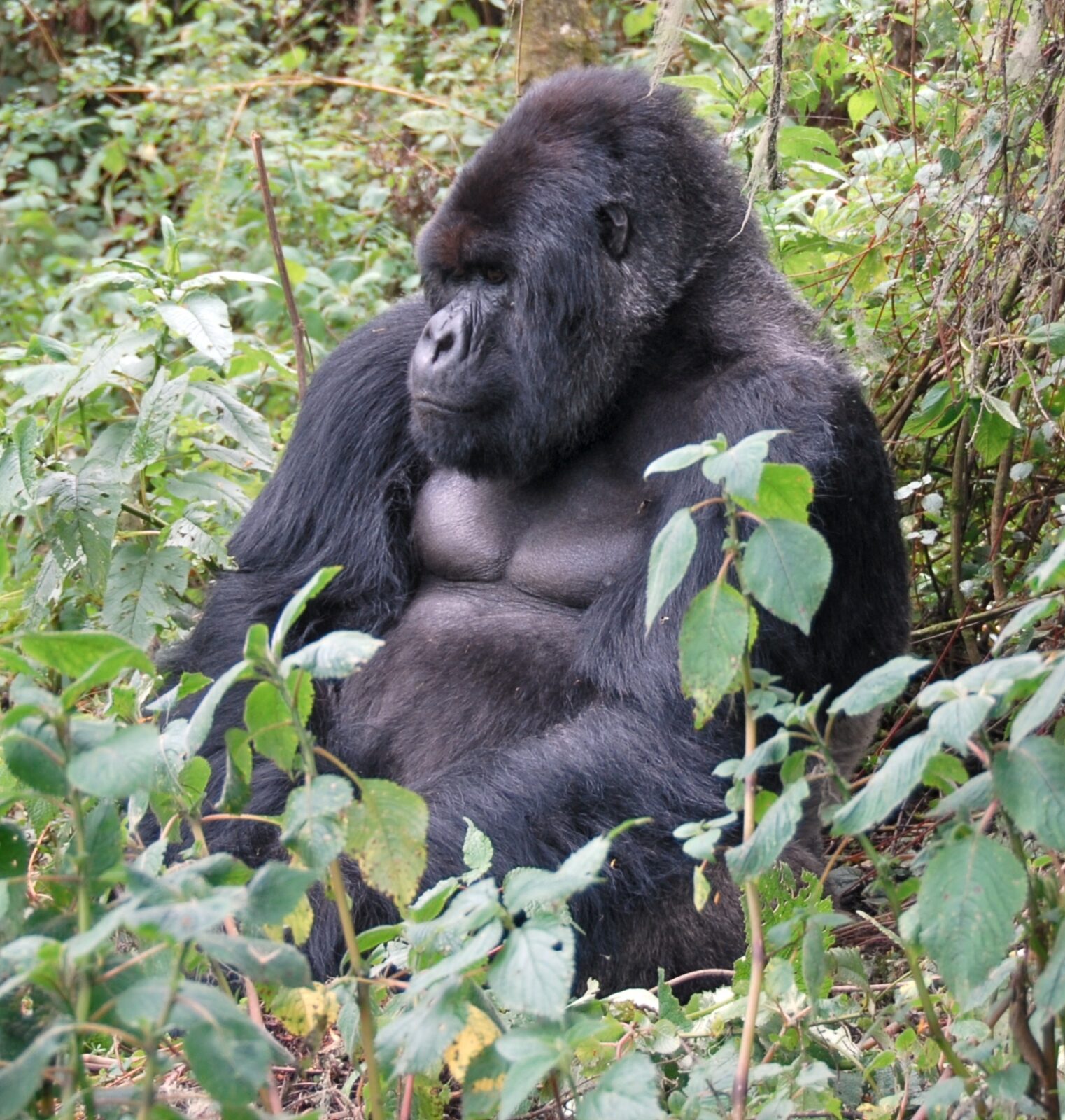
Long before you see a gorilla family on a trek, there’s a decent chance you’ll hear them first. What sound does a gorilla make is a question with a genuinely varied answer, since mountain gorillas use a surprisingly wide vocabulary of grunts, hoots, barks, and the famous chest-beating display, each carrying a distinct meaning within the family group.
Understanding this vocabulary even at a basic level, before you set off on your own trek, adds a layer of context to the encounter that most first-timers miss entirely, arriving with only the chest-beating display as a reference point and no framework for the far more frequent, quieter sounds that actually make up most of a family’s day-to-day communication.
Chest Beating: The Sound Everyone Expects
What surprises most trekkers isn’t the sound itself, which is broadly familiar from wildlife documentaries, but the sheer physical presence behind it – the volume and resonance of the display when it happens a short distance away, within a genuinely enclosed forest space rather than filtered through a television speaker. It’s a full-body display, involving the silverback rising, sometimes running sideways or breaking vegetation, with the chest-beating itself as the percussive centrepiece of a much larger performance.
Younger males and even juveniles sometimes attempt smaller, less resonant versions of the same display, practising a behaviour that will matter considerably more once they reach maturity and need to establish or defend status within a group of their own. Watching a juvenile’s clumsy attempt at chest beating next to a full silverback’s genuine display is, for many trekkers, an unexpectedly funny moment amid an otherwise awe-inspiring encounter.
This is the one most people already know from documentaries, and it’s just as striking in person – a rapid, hollow, drumming sound produced by a silverback slapping cupped hands against his chest. It’s usually a display of size and confidence rather than a precursor to aggression, often performed during excitement, a mild territorial statement, or simply as part of normal social behaviour rather than a warning specifically directed at trekkers.
Grunts and Belch Vocalisations: The Sound of Contentment
These sounds function much like ongoing quiet conversation within the family, maintaining awareness of everyone’s location and mood without requiring constant visual contact through dense vegetation. Researchers studying gorilla communication have documented subtle variations within this broad category of grunting, suggesting a more nuanced internal vocabulary than the sounds might initially seem to a casual listener encountering them for the first time on a single trek.
The most common sound you’ll actually hear during a calm trek is a low, rhythmic grunting or belching noise, often described as sounding remarkably like a deep, satisfied human belch repeated in a soft rolling pattern. This is a contentment call, used constantly during feeding and resting to maintain contact and reassurance within the group, and it’s usually the background soundtrack to most of your hour with the family rather than anything dramatic.
Screams and Roars: The Alarm Sounds
It’s worth being honest that these sounds, when they do occur, are genuinely startling – louder and sharper than most visitors expect from an animal they’ve mentally categorised as calm and gentle based on the bulk of a typical trek. This is precisely why the pre-trek briefing on how to respond matters so much: knowing intellectually, before it happens, that this is a normal part of gorilla communication rather than a sign of imminent danger makes an enormous difference to how you’re able to respond calmly in the moment itself.
Sharper, louder vocalisations – screams, roars, and barks – signal alarm, tension, or a genuine threat response, and are far less common during a standard, well-managed trek than the calmer grunting sounds. If a silverback does roar or bark during your encounter, your ranger will immediately manage the group’s positioning and behaviour, since this signals the family perceives something as a potential concern, whether that’s your group’s proximity, a rival gorilla family nearby, or something else entirely happening elsewhere in the forest that isn’t immediately obvious to your group.
Hoots and Pant-Hoots
Hearing this call echo from an unseen part of the forest is one of the more atmospheric parts of a trek, a reminder that the habituated family you’re observing exists within a much larger, largely unseen social landscape of neighbouring families, lone silverbacks, and shifting territorial boundaries that continue whether or not any trekkers happen to be present that day.
A rising series of hoots, sometimes building into a fuller pant-hoot sequence, is used for longer-distance communication between separated members of a family or between neighbouring groups. This is less common to hear up close during a standard trek but can sometimes be heard echoing from elsewhere in the forest, a reminder that the family you’re watching is only one of several sharing the wider protected area.
What Each Sound Actually Means in Context
This layered complexity is part of why long-term researchers who study specific families over years continue to publish new findings about gorilla communication – the vocabulary is genuinely rich enough that a single trek, however memorable, only scratches the surface of what’s actually being communicated within the family throughout an ordinary day in the forest.
Context matters enormously in interpreting gorilla vocalisations correctly – the same basic grunt can signal different things depending on what’s happening around it. A grunt during feeding generally signals simple contentment; the same sound directed at a specific individual during a tense moment can carry a mild disciplinary or corrective meaning. Rangers, through years of experience with specific families, read these distinctions far more precisely than a first-time visitor ever could in a single hour.
How Rangers Use Sound to Track and Interpret Behaviour
This skill develops over years rather than months – a ranger newly assigned to a sector takes time to learn the acoustic habits of specific families, since individual groups, and even individual gorillas within them, have recognisable vocal patterns that experienced staff learn to distinguish much the way you might recognise a familiar person’s voice in another room without seeing them.
Trackers often locate a family partly by sound before visual confirmation, particularly in the dense understory where visibility can be limited to just a few metres in any direction. Throughout your trek, your ranger is continuously listening as much as watching, using vocalisations as an early warning system for shifts in the family’s mood that might call for adjusting the group’s position or behaviour before a situation escalates, often noticing a change well before anyone else in the group has consciously registered anything different at all.
What to Do If You Hear a Warning Sound
It’s genuinely rare for this to escalate beyond a brief tense moment on a properly managed trek with an experienced ranger team, and the vast majority of trekkers who hear an alarm call during their encounter describe the moment resolving within seconds once the group has repositioned and the family has reassessed the situation as non-threatening.
The instructions are the same regardless of which specific alarm sound you hear: stay calm, stay quiet, follow your ranger’s positioning instructions immediately, and avoid sudden movement or eye contact with an agitated individual. These moments are rare on a well-managed trek and are almost always resolved within moments once the family reassesses the situation as non-threatening, particularly when trekkers respond calmly rather than reactively.
Frequently Asked Questions
Will I definitely hear a gorilla vocalise during my trek?
Almost certainly, even if only the soft, constant grunting that accompanies normal feeding and resting behaviour. The more dramatic sounds like chest beating or alarm calls are less guaranteed but far from rare, and many trekkers experience at least one clear display during their hour with the family.
Are gorilla sounds loud enough to hear from a distance in the forest?
Yes, particularly chest beating and louder vocalisations, which can carry a surprising distance through dense vegetation and are sometimes audible before your group has even reached the family.
Do different gorilla families have noticeably different vocal habits?
Rangers who work closely with multiple families over time often say yes, describing subtle differences in how vocal or quiet particular groups tend to be, shaped by the specific personalities of the dominant silverback and other long-term members of each family, in much the same way individual human households have their own distinct rhythms and habits.
Is it safe to record gorilla sounds on my phone or camera?
Generally yes, as long as recording doesn’t involve flash photography or require you to move closer than the mandated distance. Keep devices on silent mode otherwise, since artificial beeps or ringtones can be genuinely disruptive to the family and to fellow trekkers focused on the encounter, and consider reviewing your specific device settings the night before to avoid fumbling with them on the trail itself.
For more on interpreting gorilla behaviour more broadly, this guide to silverback behaviour and gorilla etiquette is worth reading before your trek, alongside this beginner’s guide for the rest of your planning and preparation.