
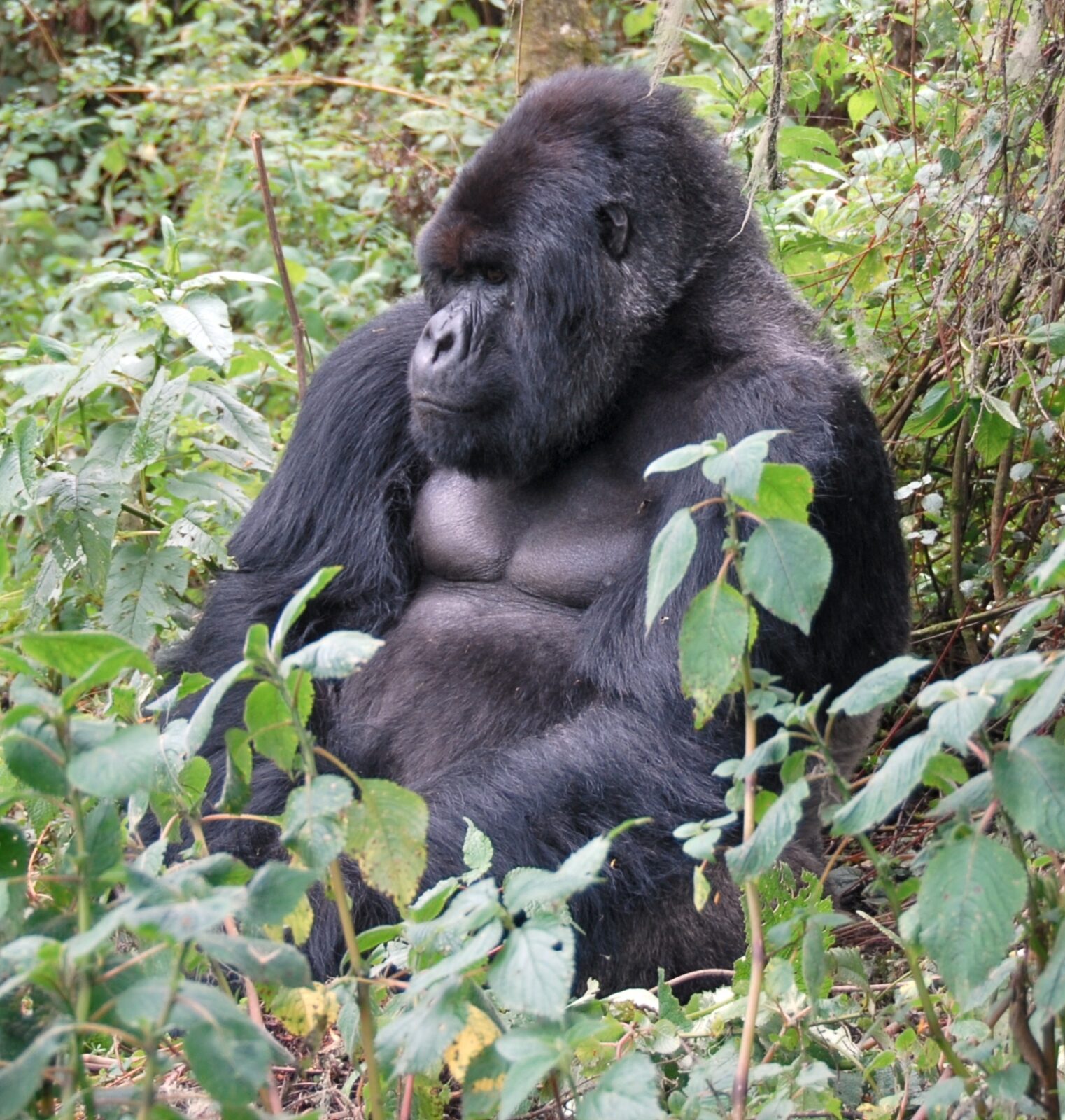
Most of what you need to know about gorilla trekking etiquette gets covered in your pre-trek briefing, but it helps to arrive already knowing the core list rather than absorbing it all in a rushed few minutes before setting off. What should you absolutely not do on a gorilla safari covers the genuinely non-negotiable rules, the ones that exist for real safety and conservation reasons rather than arbitrary caution.
Never Touch a Wild Gorilla, However Tempting It Looks
This rule sometimes surprises trekkers who’ve seen viral photos or videos suggesting closer contact happened somewhere, sometime. Whatever the circumstances of those images, they don’t reflect standard, sanctioned trekking protocol, and treating them as a benchmark for what’s acceptable on your own trek is a mistake worth avoiding entirely.
An infant might wander closer than expected, or a curious juvenile might approach your group, and the instinct to reach out is understandable but must be resisted entirely. Touching a wild gorilla risks disease transmission in both directions, given how closely related the species are genetically, and can also provoke a protective response from nearby adults who may read the contact as a threat rather than affection.
Never Use Flash Photography
Take the time to disable your camera or phone’s automatic flash setting before your trek day, rather than assuming you’ll remember to manually override it in the excitement of the actual encounter. A pre-trek gear check that includes this specific setting is a small step worth building into your routine.
A sudden bright flash can startle a wild animal at close range in genuinely unpredictable ways, and this rule is enforced strictly rather than treated as a soft suggestion. Modern cameras handle low light in dense forest reasonably well without flash, and the rule exists specifically to prevent an entirely avoidable, self-inflicted tense moment during what should be a calm encounter.
Never Approach Closer Than the Mandated Distance
It’s genuinely easy to lose track of exact distance in the excitement and dense vegetation of the moment, which is precisely why your ranger, not your own judgement, is responsible for managing positioning throughout – defer to their guidance immediately rather than trying to estimate distance yourself.
The minimum viewing distance – historically cited as around seven metres, with some current guidance suggesting a tightened distance closer to ten – exists specifically to limit disease transmission risk between species. Your ranger controls positioning throughout the encounter, and individually deciding to inch closer for a better photo undermines a rule that protects an endangered species with no built-up immunity to many human illnesses.
Never Attend a Trek While Genuinely Sick
Being honest with your operator well before trek day, the moment symptoms appear rather than at the last minute, gives everyone the best chance of arranging a sensible alternative, whether that’s a rescheduled date or simply sitting out this particular trek while others in your group proceed.
If you’re showing symptoms of a cold, flu, or any contagious illness on trek morning, tell your operator and ranger immediately rather than pushing through and hoping it isn’t noticeable. You’ll likely be asked to sit this trek out for the gorillas’ protection, and while that’s a genuine disappointment after months of planning, it’s a non-negotiable safety measure rather than an overcautious inconvenience.
Never Make Sudden Movements or Loud Noises
This applies even to reactions of pure excitement – a sudden gasp, a quick grab for your camera, an involuntary step forward when something remarkable happens. Practising a calm, contained response to excitement beforehand genuinely helps in the moment, when instinct might otherwise take over.
Calm, slow, predictable movement and a quiet voice throughout the encounter help the gorillas continue perceiving your group as non-threatening. Sudden gestures, loud talking, or unexpected noise can startle a family that’s otherwise entirely relaxed around trekkers who behave predictably, turning a calm encounter into an unnecessarily tense one.
Never Maintain Prolonged Direct Eye Contact
This nuance sometimes confuses first-time trekkers, who arrive expecting a strict, blanket no-eye-contact rule rather than the more accurate reality that brief, natural glances are entirely normal – it’s the sustained, deliberate stare that carries the risk, not an ordinary passing look.
Brief, natural glances are fine, but holding a sustained, direct stare with a gorilla, particularly a silverback, can be read within gorilla body language as a challenge rather than simple curiosity. Your ranger will guide appropriate behaviour throughout, but understanding this rule beforehand helps you self-correct instinctively rather than needing constant reminders.
Never Leave Litter or Food Waste in the Forest
This includes small items easy to overlook – a dropped energy bar wrapper, a tissue, even biodegradable items like fruit peel, which can still alter local wildlife behaviour and doesn’t belong in an otherwise pristine, carefully protected ecosystem regardless of how quickly it might naturally decompose.
Anything you bring into the park should leave with you, without exception. Food waste in particular can alter gorilla behaviour around humans in ways conservationists actively work to prevent, encouraging unhealthy food-seeking behaviour that damages the delicate balance of a genuinely wild, non-dependent population.
Never Ignore a Ranger’s Instruction, Even If It Seems Unnecessary
This is arguably the single umbrella rule that all the others fall under – if you internalise nothing else from this list, internalise a default posture of immediate, unquestioning compliance with your ranger throughout the encounter, and the rest largely takes care of itself.
Your ranger is reading subtle behavioural cues you likely can’t interpret yourself, informed by years of experience with that specific family. An instruction to back away, stay quiet, or reposition should be followed immediately and without hesitation or negotiation, even if the reason isn’t immediately obvious to you in the moment.
Why These Rules Exist Together as a System
It’s worth understanding that none of these rules function in isolation – they work together as a coordinated system designed around two goals simultaneously: protecting an endangered species with limited immunity to human disease, and maintaining the calm, predictable dynamic that allows habituated families to tolerate close human observation at all. Break one rule and you’re not just risking that specific consequence; you’re potentially undermining the broader trust between habituated gorillas and the human visitors who depend on that trust continuing to hold.
This is also why rangers take enforcement seriously rather than treating any of these as soft suggestions open to individual interpretation. The entire tourism model, and by extension a meaningful share of the conservation funding protecting the species, depends on this system continuing to work reliably, trek after trek, for thousands of visitors every year.
Frequently Asked Questions
What happens if someone in my group accidentally breaks one of these rules?
Your ranger will manage the situation immediately, typically by calmly repositioning the group or addressing the behaviour directly. Minor accidental lapses are usually resolved without lasting consequence, though deliberate or repeated violations can result in a trek being cut short.
Are these rules the same across Uganda, Rwanda, and Congo?
Yes, the core behavioural rules are consistent across all three countries’ gorilla trekking programmes, since they’re based on the same underlying conservation and safety science rather than differing by national policy.
Is it acceptable to ask my ranger questions during the encounter itself?
Quiet, brief questions are generally fine and rangers are usually happy to answer, but keep your voice low and avoid extended conversation that could distract from monitoring the family’s behaviour throughout your limited hour.
For more on gorilla behaviour and how to read it, this guide to gorilla etiquette and silverback behaviour is worth reading closely, alongside this beginner’s guide for the rest of your trip planning.