
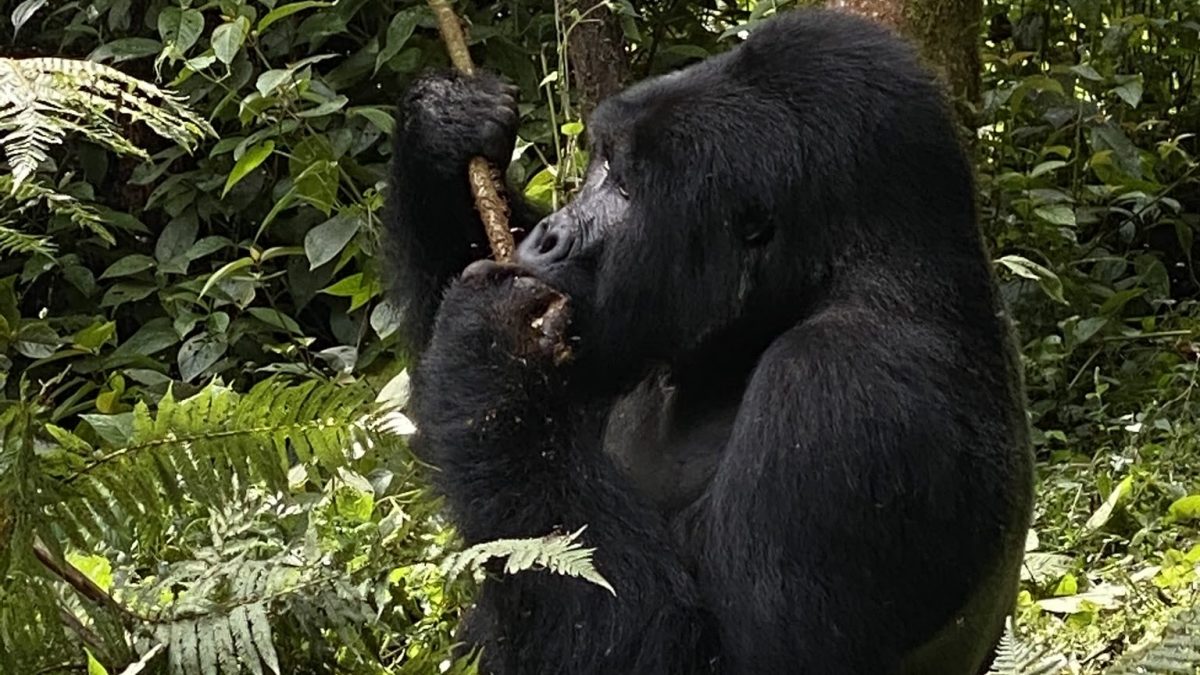
Gorilla Safari Tool Use: Evidence for Gorilla Intelligence
When most travelers think of gorilla safaris, they imagine powerful silverbacks, gentle mothers, and playful juveniles moving through the forest. What is less obvious-but deeply important-is that gorillas are also highly intelligent animals capable of problem-solving, learning, and in some cases, limited tool use.
While chimpanzees are more famous for using tools regularly, gorillas also show clear signs of cognitive ability that challenge outdated ideas of “simple instinct-driven behavior.” Observations from habituated groups in parks such as Bwindi Impenetrable National Park, Volcanoes National Park, and Virunga National Park have helped researchers document intelligence through behavior, social learning, and occasional tool-related actions.
Gorilla intelligence is not about human-like technology. It is about adaptation, awareness, memory, social learning, and creative responses to environmental challenges.
Do gorillas use tools in the wild?
Yes, but tool use in gorillas is rare and less developed than in chimpanzees.
Gorillas are not habitual tool users in the way some primates are, but they have been observed using natural objects in functional ways under certain conditions.
Documented examples include:
Using sticks to test water depth
Using branches for balance while crossing swampy areas
Using vegetation as improvised walking supports
Using leaves as protective coverings in rain
Using sticks to assist in feeding or probing
These behaviors are not consistent across all populations, but they provide clear evidence of cognitive flexibility.
Why gorillas use tools less frequently than chimpanzees
The difference in tool use between gorillas and chimpanzees is mainly ecological and behavioral rather than intellectual.
Chimpanzees live in environments where food extraction often requires problem-solving, such as cracking nuts or fishing for termites. This creates strong evolutionary pressure for frequent tool use.
Gorillas, especially mountain gorillas, primarily feed on easily accessible vegetation like leaves, shoots, stems, and bark. Their diet does not require complex extraction methods, reducing the need for tools.
In simple terms, gorillas do not rely heavily on tools because their environment does not demand it.
Evidence of gorilla intelligence beyond tools
Even without frequent tool use, gorillas demonstrate high cognitive ability in many other ways.
Problem-solving ability
Gorillas can navigate complex forest terrain, find seasonal food sources, and adjust movement patterns based on environmental conditions.
They make decisions about where to rest, feed, and travel as a group, often led by the silverback.
Memory and spatial awareness
Gorillas have strong memory for feeding locations, nesting sites, and safe travel routes.
This spatial awareness is crucial in dense forests where visibility is limited and resources are scattered.
Social intelligence
One of the strongest indicators of gorilla intelligence is their complex social structure.
Within family groups, individuals recognize relationships, hierarchies, emotional cues, and long-term bonds.
The ability to maintain stable family systems over many years requires advanced social cognition.
Emotional behavior
Gorillas show behaviors associated with emotion such as:
Grief-like responses to loss
Playfulness in juveniles
Protective parenting
Affection through grooming and touch
Calm reassurance from silverbacks
These behaviors reflect not just instinct but flexible emotional processing.
Observed cases of tool-related behavior
Although rare, researchers have recorded interesting instances that suggest gorillas can experiment with tools.
In some rainforest environments, gorillas have been seen using branches to stabilize themselves in swampy ground or shallow water crossings.
Others have been observed manipulating vegetation in ways that suggest exploratory problem-solving rather than simple feeding.
However, unlike chimpanzees, gorillas do not consistently pass tool-use behavior culturally through generations.
Each observed case tends to be situational rather than habitual.
What gorilla intelligence means for safari experiences
During gorilla trekking, many of the behaviors visitors observe reflect cognitive depth rather than instinct alone.
For example:
A silverback positioning himself between perceived threats and the family shows decision-making and protective strategy.
Mothers adjusting infant positioning during movement shows planning and care optimization.
Juveniles learning through imitation demonstrates social learning.
Group coordination during travel through dense forest shows collective decision-making.
These behaviors reveal intelligence in action even without visible tools.
Comparison with chimpanzee intelligence
Chimpanzees are often considered the most tool-using non-human primates, with documented behaviors such as using sticks for termite fishing, stones for nut cracking, and leaves for drinking water.
Gorillas, by contrast, show less frequent tool use but stronger emphasis on social structure, emotional stability, and environmental adaptation.
This difference does not mean one species is “smarter” than the other. It reflects different evolutionary pressures and survival strategies.
Chimpanzees evolved in environments where extracting food required manipulation.
Gorillas evolved in environments where efficient vegetation feeding and group stability were more important.
Why gorilla intelligence is often underestimated
Historically, gorillas were misunderstood as simple or passive animals. Early misconceptions portrayed them as aggressive or unintelligent due to limited observation and fear-based narratives.
Modern research has corrected this view significantly.
Long-term field studies in habituated populations have revealed that gorillas possess:
Strong memory systems
Complex emotional behavior
Advanced social organization
Adaptive problem-solving abilities
Because gorillas are more calm and less visibly tool-oriented than chimpanzees, their intelligence is often less obvious to casual observers.
How habituation reveals intelligence
Habituated gorilla groups, such as those visited in protected areas like Bwindi or Volcanoes National Park, provide researchers with long-term behavioral data.
Through habituation, scientists observe:
How gorillas respond to humans over time
How they adapt movement patterns
How juveniles learn behavior from adults
How silverbacks make leadership decisions
This long-term observation confirms that gorillas are capable of learning, adaptation, and social awareness rather than fixed instinct alone.
What tourists can observe during trekking
Visitors on gorilla safari can see many subtle indicators of intelligence if they pay attention beyond just appearance.
Examples include:
Juveniles copying adult feeding behavior
Mothers adjusting movement to protect infants
Silverbacks monitoring group safety continuously
Gorillas choosing specific resting sites based on conditions
Coordinated group movement through difficult terrain
Even without tools, these behaviors demonstrate planning and awareness.
Why gorilla intelligence matters for conservation
Recognizing gorilla intelligence is not just academic-it directly supports conservation efforts.
When people understand that gorillas are cognitively complex, emotionally aware, and socially sophisticated, they are more likely to support protection efforts.
This has helped increase funding for conservation programs, improve tourism ethics, and strengthen anti-poaching initiatives.
Gorilla intelligence also reinforces the importance of minimizing human disturbance during trekking, as these animals are sensitive to environmental and social disruption.
Thoughts
Gorilla tool use may be rare, but intelligence in gorillas is not limited to tools. It is expressed through social structure, memory, emotional behavior, problem-solving, and adaptation to complex forest environments.
While chimpanzees may show more frequent and visible tool use, gorillas demonstrate intelligence in quieter but equally sophisticated ways-especially in family bonding, leadership, and environmental awareness.
For travelers on safari, understanding gorilla intelligence transforms the experience. What may first appear as simple forest movement becomes a deeper encounter with one of the most intelligent and emotionally complex species on the planet.