
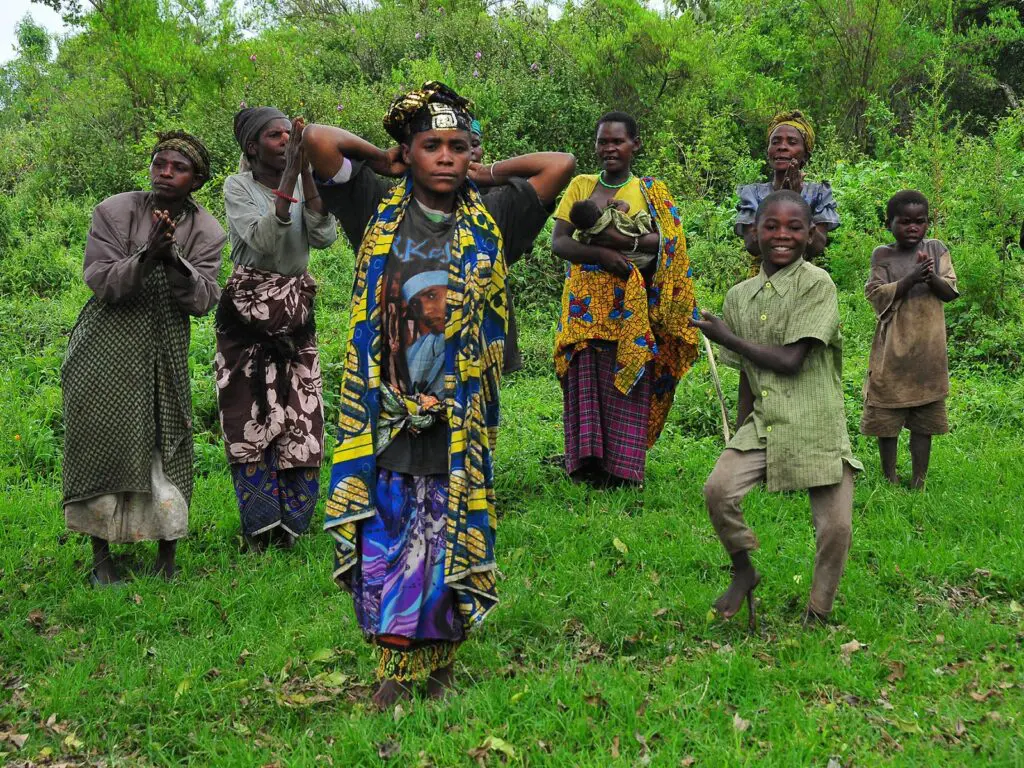
Batwa Pygmy People of Bwindi: Their History and Conservation Role
Most travelers arrive at Bwindi having researched permit costs, trekking difficulty, and packing lists in exhaustive detail, yet leave without ever learning who lived in this forest before it became a national park. The Batwa pygmy people of Bwindi carry a history that is considerably more complicated, and considerably more important to understand honestly and in full, than the brief cultural-tourism framing many visitors encounter before or during their trip. The Batwa are among the oldest indigenous peoples of Central and East Africa, forest-dwelling hunter-gatherers who lived within Bwindi’s dense canopy and the surrounding Albertine Rift highlands for countless generations before conservation policy, in a single administrative decision, fundamentally severed their relationship with the land their culture had been built around.
A Forest-Based Life Built Over Centuries
Long before Bwindi carried any formal protective designation, the Batwa lived as skilled hunter-gatherers deeply integrated into the forest ecosystem, developing intimate practical knowledge of its plants, animals, and seasonal patterns that took generations to accumulate. Their traditional way of life, contrary to a common misconception, operated in genuine ecological balance with the forest rather than threatening it; small-scale, low-impact hunting and gathering practices coexisted with the same biodiversity that later became the basis for the park’s conservation value, including the mountain gorillas that eventually made Bwindi world famous. This point matters because it directly undercuts a narrative sometimes used to justify displacement policies broadly, the assumption that indigenous forest-dwelling communities inherently threaten conservation goals, when the historical record in Bwindi’s specific case points instead toward centuries of demonstrated coexistence rather than conflict between Batwa land use and the ecosystem’s long-term health.
The 1991 Displacement
When the Ugandan government formally established Bwindi Impenetrable National Park in 1991, elevating its protection status specifically to safeguard mountain gorilla habitat, the Batwa were evicted from the forest with no compensation and, by most documented accounts, no meaningful consultation beforehand. More than a thousand community members lost access to the land and resources their entire way of life depended on, forced onto marginal land at the forest’s edge with little or no support for the fundamentally different livelihood, farming rather than hunting and gathering, this abrupt shift demanded of them. Many Batwa found themselves working as laborers for neighboring farming communities on land that offered nothing comparable to what the forest had provided, a transition scholars studying conservation history have since characterized as a stark example of “fortress conservation,” a model that prioritizes strict, exclusionary environmental protection over the rights and knowledge of the indigenous communities who had sustainably inhabited and carefully stewarded the land for generations before them.
This history sits in genuine, difficult tension with Bwindi’s celebrated conservation success. The same 1991 decision that helped set mountain gorillas on their remarkable recovery trajectory also displaced a community whose own traditional practices had coexisted with those same gorillas for centuries without threatening their survival, a tension worth understanding honestly and directly rather than smoothing over in service of a simpler, more comfortable conservation narrative that skips past the human cost entirely.
Ongoing Advocacy and Indigenous Rights
The Batwa, throughout the decades since 1991, have not accepted this displacement passively or quietly. Batwa-led organizations and advocates have consistently pushed for recognition of indigenous rights, meaningful compensation for their forced displacement, and, in some cases, restored access to ancestral forest land, part of a broader global movement toward what advocates describe as land-back and self-determination initiatives for indigenous communities affected by conservation policy worldwide. These efforts have achieved only partial success to date, and significant unresolved grievances remain a genuine, active part of the Batwa’s contemporary situation rather than a fully settled historical chapter. Regional and international human rights bodies have periodically engaged with these grievances as well, adding external pressure and visibility to advocacy that Batwa organizations themselves have sustained for decades, though translating that attention into concrete policy change has proven a slow, incremental process rather than a swift resolution.
Their Role in Conservation Today
Despite this difficult history, the Batwa’s deep forest knowledge has found a place, however imperfect and incomplete, within Bwindi’s modern conservation and tourism economy. Some Batwa individuals work as guides for cultural walks and forest knowledge-sharing experiences, drawing directly on traditional expertise passed down through generations. Others find employment in the hotels and tourism infrastructure that developed around gorilla trekking, and some sell traditional crafts directly to visitors as a further source of income. This represents genuinely meaningful economic opportunity for the individuals and families involved, but it is worth being clear-eyed about its real limits: cultural tourism income and hospitality employment, however welcome, do not equate to restored land rights or full redress for the original displacement, and advocacy for more complete indigenous rights recognition continues alongside these more limited economic accommodations. NGOs and community-based organizations have also worked to address more basic welfare needs, schools, health centers, and housing support, in Batwa settlement areas, filling gaps left by the original displacement’s lack of any formal resettlement plan or compensation, though these efforts remain, by most independent accounts, insufficient relative to the scale of what was lost. Some of these programs are run in direct partnership with Batwa community leadership rather than designed externally and imposed, a distinction advocates consider genuinely important, since programs shaped with meaningful community input tend to address actual, expressed needs more effectively than well-intentioned outside interventions designed without that same level of direct consultation.
What Traditional Batwa Knowledge Actually Included
Understanding the depth of what was lost in 1991 requires appreciating just how sophisticated Batwa forest knowledge genuinely was. Traditional practices included detailed ethnobotanical knowledge, identifying and preparing dozens of forest plants for medicinal use, treating everything from wounds to digestive ailments with remedies refined over generations of trial and observation. Hunting techniques were similarly refined, using nets, snares, and deep knowledge of animal behavior and forest terrain to sustain communities without depleting the resources they depended on, a genuinely sustainable model of resource use quite unlike the destructive commercial poaching that later became a separate, serious threat to gorillas once entirely different actors, driven by external markets rather than subsistence need, entered the picture. Honey gathering, fire-making, shelter construction, and clothing production from forest materials rounded out a comprehensive body of practical knowledge that, once the community lost daily access to the forest, began eroding within a single generation as younger Batwa grew up without the same immersive forest apprenticeship their parents and grandparents had experienced. Some of this knowledge survives specifically because elders continued teaching it deliberately, even without daily forest access, and it is this preserved, actively maintained knowledge, rather than something reconstructed after the fact, that Batwa guides draw on during today’s cultural walks.
Comparing This History to Rwanda and the DRC
The Batwa’s displacement from Bwindi mirrors a broader regional pattern, since Batwa communities across Rwanda and the Democratic Republic of Congo experienced comparable displacement as those countries similarly established protected areas around the Virunga Massif’s gorilla habitat. This shared history across all three countries reflects a common colonial and post-colonial conservation approach throughout the region, prioritizing strict habitat protection over indigenous land rights, a pattern conservation scholars and indigenous rights advocates have increasingly scrutinized across East and Central Africa more broadly as this history receives more thorough documentation and reckoning in recent decades. Comparing the three countries’ approaches also reveals meaningful differences in how each government has since engaged with Batwa advocacy and resettlement questions, differences worth understanding for anyone researching this history across the wider Virunga Massif region rather than treating it as a single, uniform story repeated identically in each country.
Engaging With This History Respectfully
Visitors who want to understand Bwindi fully, not just its wildlife but the complete human story woven into its conservation history, should approach Batwa cultural experiences as an opportunity for genuine listening and respectful engagement rather than simple entertainment. Our page on community walks near Bwindi covers what a guided Batwa cultural experience actually involves in practice, and our broader piece on the history of Bwindi National Park covers the fuller conservation timeline this displacement sits within. Our page on how gorilla rangers protect Bwindi today touches on the broader community employment picture within the park’s modern conservation workforce. A well-paced three-day Bwindi gorilla trekking safari that includes time to genuinely engage with this history offers a fuller, more honest understanding of everything that made your gorilla encounter possible, not just the conservation success story, but the real human cost that came alongside it. Understanding the Batwa pygmy people of Bwindi as living participants in an ongoing story, not simply a footnote in the forest’s conservation history, is a small but meaningful way to travel here with genuinely open eyes. It does not require becoming an expert in the full policy history overnight, simply approaching the topic with the same curiosity and willingness to sit with complexity that a visitor would naturally bring to any other genuinely significant piece of the region’s history.