
Flora of Bwindi: The Unique Plants of Uganda’s Ancient Rainforest
Ask most gorilla trekkers what they specifically remember about Bwindi’s plant life afterward, and the honest answer is usually just stinging nettles and mud, a real shame given how genuinely remarkable and surprisingly underappreciated the underlying botanical story actually is. The flora of Bwindi genuinely rarely gets a second glance from visitors focused entirely on gorillas, yet the forest’s plant life is genuinely extraordinary in its own right, a botanical foundation over 25,000 years in the making that directly sustains everything else the park is famous for. Bwindi hosts more than 324 recorded tree species, including ten found nowhere else in Uganda, alongside over 1,000 flowering plant species and more than 110 fern species, a level of botanical diversity that places this single, relatively modest-sized forest among the richest plant communities found anywhere on the entire African continent. Few visitors arrive expecting a botanical experience of this scale, and part of what makes Bwindi’s plant diversity so easy to overlook is precisely how effortlessly it blends into the background of a trek focused on a single, far more charismatic species.
The Trees That Define the Forest’s Structure
Mahogany and various fig tree species dominate much of Bwindi’s upper canopy, forming the towering, structurally complex upper layer that gives the forest its characteristic density and, ultimately, its “impenetrable” reputation. Roughly forty percent of the forest qualifies as medium-rich to rich mixed forest, hosting key species including red stinkwood, more formally known as Prunus africana, alongside the nationally threatened Newtonia buchanani, Symphonia globulifera, Chrysophyllum pruniforme, and several Podocarpus species. This mix of common, ecologically dominant species alongside rarer, threatened ones reflects the forest’s genuine conservation significance extending well beyond its famous gorilla population into the plant community that makes gorilla habitat possible in the first place. Botanists who have spent years studying Bwindi have specifically noted that its combination of lowland and montane species existing together within a single, relatively compact protected area is itself genuinely unusual, a direct product of the altitude gradient covered in more detail in our broader ecology guide. Most of these dominant canopy trees are genuinely old, decades or in some cases centuries old, and their sheer physical scale, trunks that can take several people joining hands to encircle, is itself a quiet reminder of just how long this specific patch of forest has been left largely undisturbed.
Medicinal Plants and Traditional Knowledge
Bwindi’s plant diversity carries deep cultural as well as ecological significance, particularly for the Batwa communities who developed sophisticated traditional medicinal knowledge from generations of close forest observation. Researchers have documented well over ninety-one distinct herb species within the park, with roughly twenty-two percent of them traditionally harvested for various medicinal purposes over generations. Prunus africana stands out as perhaps the most significant medicinal species, its bark long used in traditional treatment of urinary tract and prostate-related conditions, valued for its anti-inflammatory and diuretic properties well before Western pharmaceutical research began separately investigating similar compounds derived from the same tree decades later. This overlap between traditional ethnobotanical knowledge and later formal pharmaceutical interest is a pattern that recurs across many of Bwindi’s medicinal species, underscoring just how much genuine scientific value was embedded in traditional Batwa forest knowledge long before any of it was independently validated through Western research methods. Hagenia abyssinica and Nuxia congesta round out a short list of particularly significant medicinal species, each carrying specific traditional uses and cultural importance passed down through generations of forest-based communities.
Why This Botanical Diversity Matters for Gorillas
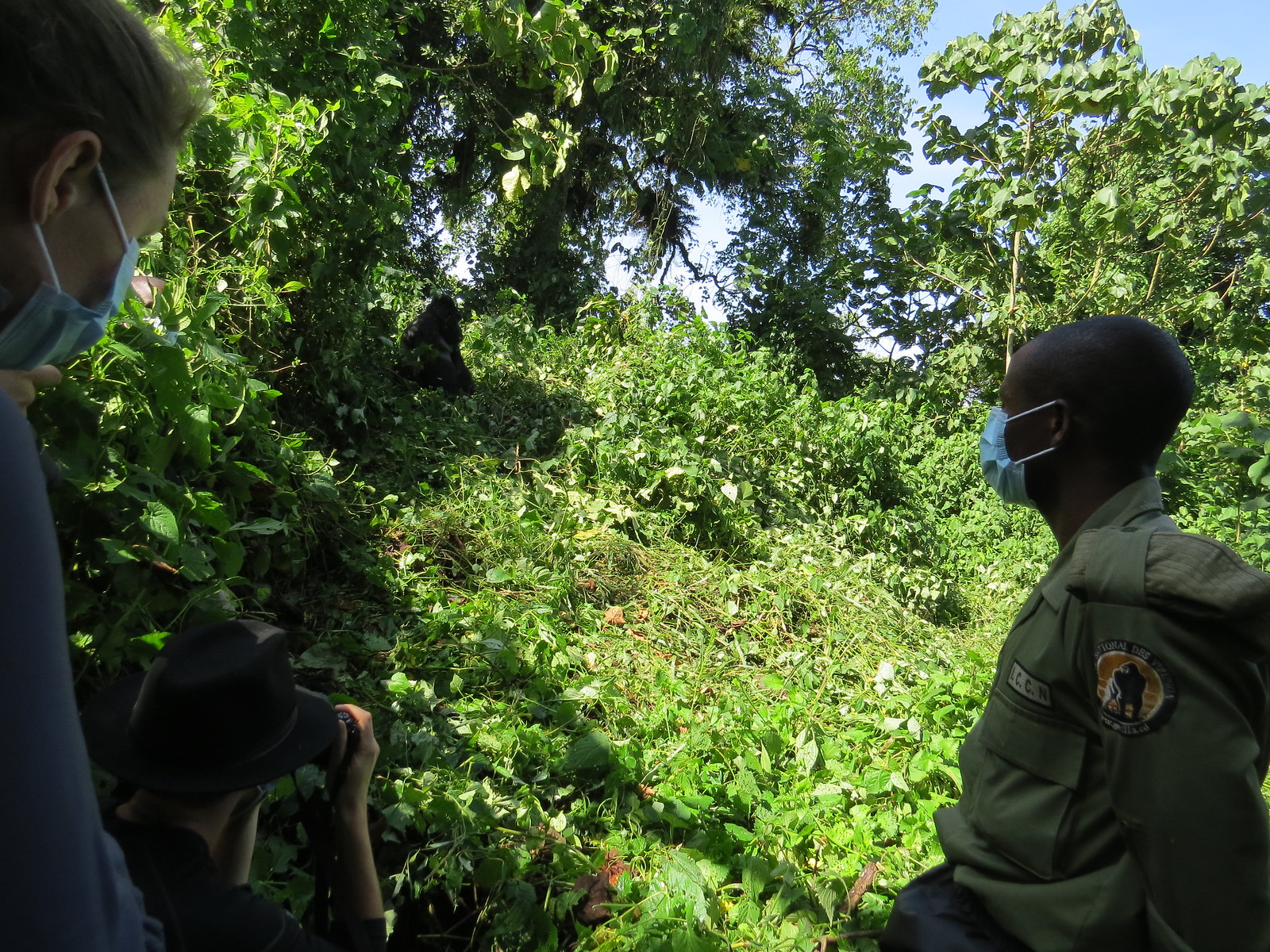
This extraordinary plant diversity directly sustains Bwindi’s mountain gorilla population, whose diet depends on a wide range of forest vegetation across different vegetation zones and seasons. Wild celery, bamboo shoots where seasonally available, various fruits, and specific leaves and stems all draw on this underlying botanical richness, and the forest’s structural complexity, dense understory, varied canopy layers, abundant climbing vines and lianas, also provides the physical habitat structure gorillas depend on for both feeding and nesting. Understanding this connection reframes a gorilla trek as fundamentally dependent on plant conservation, not simply animal conservation, since protecting gorilla habitat means protecting this entire layered botanical ecosystem rather than the gorillas alone. This is part of why anti-poaching patrols and forest protection work described in our page on how rangers protect Bwindi extend well beyond monitoring the gorillas themselves, since a healthy, intact plant community upstream of any given family’s territory is just as essential to that family’s long-term survival as direct protection from poachers ever is.
Experiencing Bwindi’s Flora Firsthand
Most gorilla trekking guides can point out specific notable plant species along the trail if asked directly, though this level of botanical detail rarely comes up entirely unprompted during a trek focused primarily and understandably on locating the day’s assigned gorilla family. Visitors with a genuine interest in Bwindi’s plant life should ask their guide directly about specific species encountered along the trail, since many rangers and trekking guides carry genuine, often surprisingly deep botanical knowledge worth drawing out with the right questions, knowledge built up over years of walking the same trails and noticing the same recurring species long before any visitor ever asked about them directly. Dedicated nature walks, distinct from the standard gorilla trek, offer an even better opportunity to slow down and engage with this botanical richness in more depth, without the faster pace a gorilla-focused trek generally demands. Our page on birding in Bwindi covers a similar dedicated-walk approach worth pairing with a plant-focused outing, since both activities reward the same slower, more observant pace.
Vines, Epiphytes, and the Forest’s Vertical Layers
Beyond the towering canopy trees, Bwindi’s flora includes a rich tangle of climbing vines and lianas that weave through the understory and canopy alike, contributing significantly and visibly to the forest’s genuinely dense, difficult-to-navigate character and giving the park its “impenetrable” name arguably just as much as any single towering tree species does on its own. Epiphytic plants, mosses, ferns, and orchids growing directly on tree trunks and branches rather than rooted in soil, thrive in Bwindi’s consistently humid, misty conditions, adding yet another layer of botanical diversity to an already remarkably complex ecosystem. Orchid enthusiasts in particular find Bwindi genuinely rewarding to explore, since the park’s cool, moist montane conditions support numerous orchid species that bloom at various points throughout the year, though spotting them often requires the kind of slower, more observant pace that a dedicated nature walk affords far better than a gorilla-focused trek moving quickly toward a specific destination. Bwindi’s orchid diversity remains less thoroughly catalogued than its tree and larger flowering plant species, meaning even experienced botanists occasionally encounter specimens whose full identification requires further study, a small but genuine reminder that this forest still has scientific surprises left to offer after decades of research attention.
Conservation Threats Facing Bwindi’s Plant Life
Despite formal protection since 1991, Bwindi’s flora faces ongoing pressure from activities including illegal harvesting of high-value medicinal species like Prunus africana, whose bark commands genuine commercial value in traditional and, increasingly, pharmaceutical markets, creating an incentive for illegal extraction that rangers work to prevent alongside their better-known anti-poaching patrols focused on animal populations. Climate change presents a longer-term, more diffuse threat to the specific temperature and rainfall patterns Bwindi’s plant communities have adapted to over millennia, a concern conservationists increasingly factor into their long-term habitat management planning even though its effects remain considerably harder to observe directly than the more immediate, visible threat of illegal harvesting. Invasive plant species introduced along the park’s edges present a further, less-discussed pressure, competing with native flora at forest boundaries and requiring active management to prevent them from establishing further into the park’s core, undisturbed sections over time.
Planning a Trip That Notices the Forest, Not Just the Gorillas
Our page on the ecology of Bwindi covers the broader environmental context this remarkable plant diversity ultimately fits within, and our piece on community walks near Bwindi is worth reading if traditional medicinal plant knowledge specifically interests you, since Batwa guides very often incorporate this specific traditional expertise directly into their cultural walks, sharing plant knowledge alongside the broader forest-life history covered on that page. A well-paced three-day Bwindi gorilla trekking safari gives you the flexibility to ask questions and genuinely notice the flora of Bwindi along the way, an ancient, richly diverse plant community that made everything else about this remarkable forest possible. The flora of Bwindi deserves at least a fraction of the attention its gorillas receive, and even a few genuine questions to your guide about the trees and plants passing by can turn an already unforgettable trek into a considerably richer one. Visitors who take even ten or fifteen minutes to ask about the specific trees, vines, and understory plants along their route often come away describing the trek itself differently afterward, less a single-minded march toward a wildlife encounter and more a genuinely immersive walk through one of the most botanically significant forests left standing anywhere on the continent.