
Gorilla Safari and Chimp Trek: The Primate Double Experience
A gorilla and chimpanzee combined safari is one of the most complete primate experiences available in Africa, offering two very different but equally compelling encounters within a single journey. In Uganda, this double experience typically combines trekking for mountain gorillas in Bwindi Impenetrable National Park with chimpanzee tracking in forests such as Kibale or Kyambura. The result is a layered wildlife journey that contrasts the calm, slow social world of gorillas with the fast, vocal, and highly dynamic behavior of chimpanzees.
This combination is not just about seeing two primates. It is about understanding two distinct evolutionary strategies within the same ecosystem region, and how each species interacts differently with its environment, social structure, and human observers.
The Concept of a Primate Double Experience
The primate double experience is designed around the idea that gorillas and chimpanzees offer complementary insights into primate behavior. Gorillas are largely terrestrial, slow-moving, and organized around a dominant silverback with a stable family structure. Chimpanzees, by contrast, are highly mobile, politically complex, and emotionally expressive, often forming shifting alliances within large communities.
By combining both experiences, travelers gain a broader understanding of primate intelligence and social evolution. The contrast between the two encounters is often what makes the journey memorable.
Gorilla Trekking: The Grounded Forest Giants
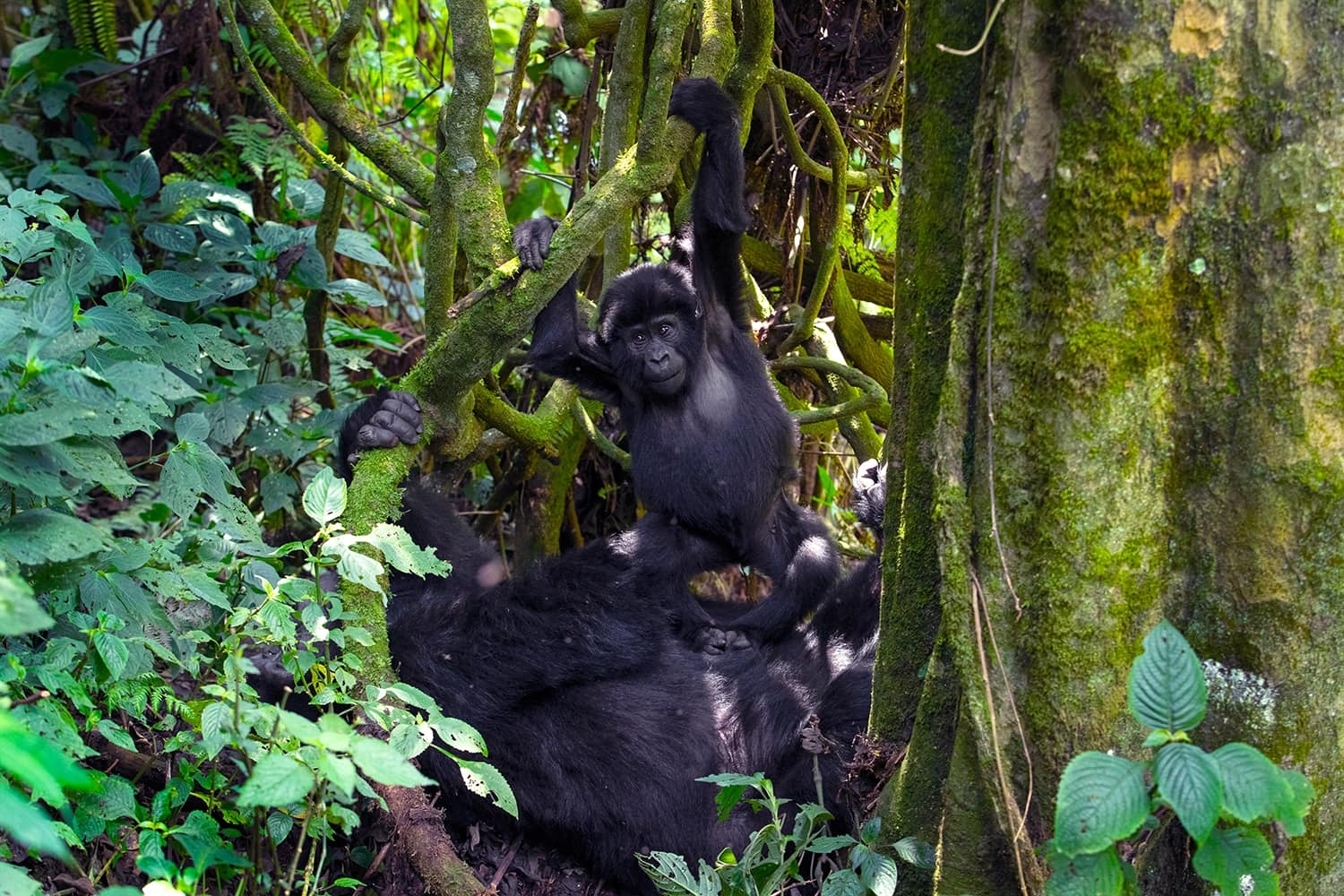
Gorilla trekking in Bwindi is a structured, conservation-focused experience that takes place in dense montane rainforest. The terrain is steep, heavily vegetated, and physically demanding, but the reward is direct observation of one of the world’s most endangered species.
Mountain gorillas live in cohesive family groups led by a dominant silverback. Their behavior is generally calm and predictable, centered around feeding, resting, grooming, and protecting the group. When you encounter them, the experience is often quiet and observational rather than chaotic or fast-paced.
The interaction is governed by strict rules. Only a limited number of visitors are allowed per group, and time with the gorillas is restricted to one hour to minimize disturbance. This controlled structure ensures that gorilla tourism remains sustainable and non-intrusive.
What makes this experience powerful is the sense of proximity. Despite the physical strength of the animals, there is often a surprising sense of calm, as if the gorillas have accepted your presence within their space.
Chimpanzee Tracking: The Fast-Moving Forest Intelligence
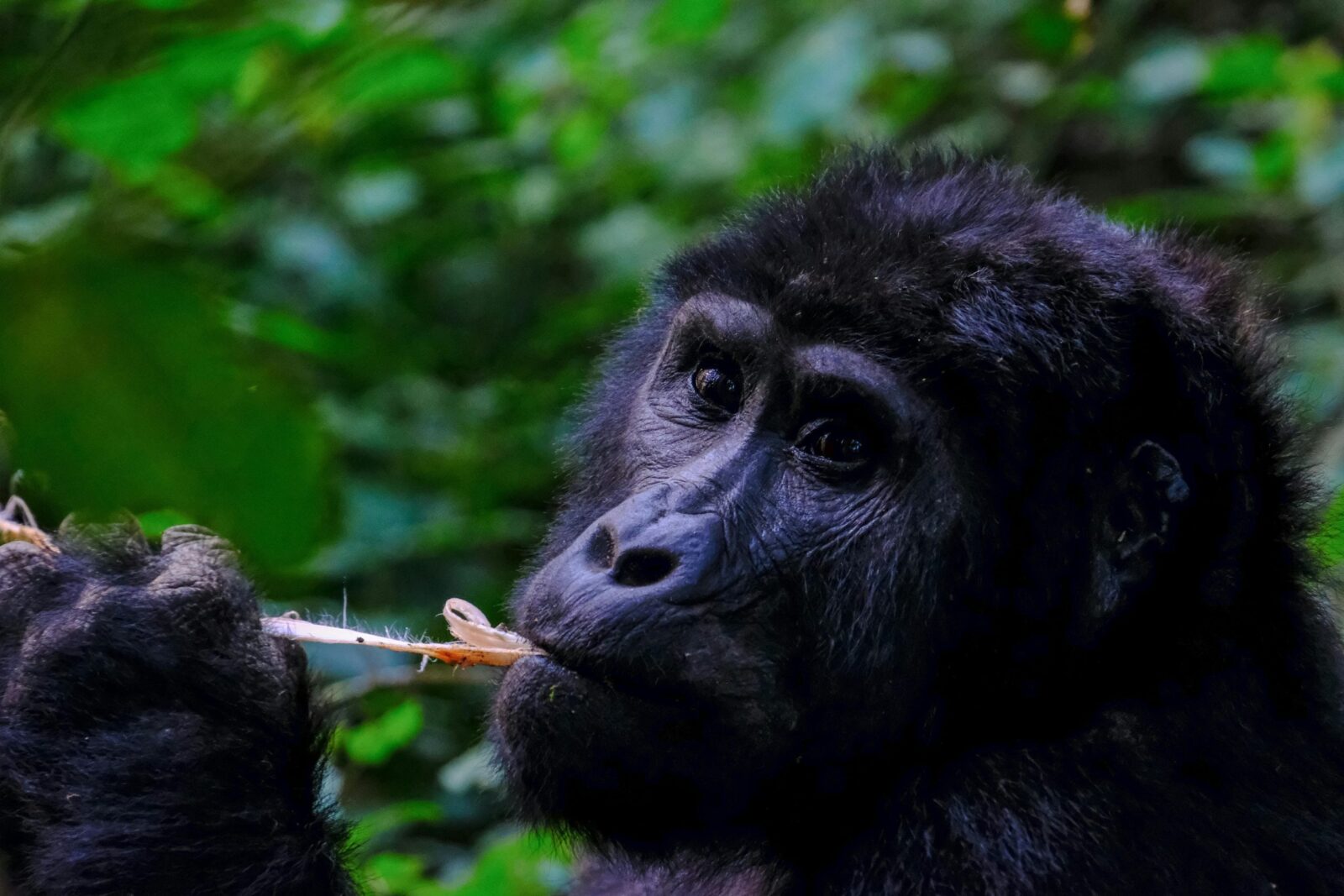
Chimpanzee trekking offers a completely different rhythm. Chimpanzees are more energetic, vocal, and unpredictable than gorillas. They move quickly through the forest canopy and forest floor, often communicating constantly through calls, gestures, and physical movement.
In Uganda, chimpanzee tracking is commonly conducted in locations such as Kibale Forest or Kyambura Gorge. These environments are structurally different from Bwindi’s dense montane forest, often featuring a mix of tropical rainforest and more open canopy sections.
Unlike gorilla trekking, chimpanzee encounters are often more dynamic. Groups may split, reunite, or move rapidly across large distances. This makes tracking more active and sometimes more challenging, requiring guides to follow vocal cues and feeding patterns.
Chimpanzees also exhibit a wider range of behaviors during observation. You may witness hunting, tool use, grooming politics, or sudden bursts of social interaction. This unpredictability is what makes chimp trekking intellectually engaging.
Contrasting Social Structures
One of the most important aspects of the double experience is the contrast in social organization between gorillas and chimpanzees.
Gorilla groups are typically stable and hierarchical, centered around a dominant silverback who maintains order through presence rather than aggression. Conflicts are rare and usually resolved through displays rather than physical confrontation.
Chimpanzee communities are more fluid and politically complex. Leadership is not fixed, and dominance can shift based on alliances, strength, and intelligence. Social interactions can be intense, with both cooperation and competition occurring frequently.
This difference becomes immediately apparent when transitioning from one trek to the other. It is not just a change in species; it is a shift in social philosophy within the animal kingdom.
Physical Experience and Terrain Differences
The physical demands of gorilla trekking in Bwindi are generally higher than chimpanzee tracking. The terrain is steep, muddy, and heavily forested, requiring endurance and careful footing. Trek durations vary depending on gorilla movement, sometimes extending for several hours.
Chimpanzee trekking, while still physically active, is often less vertically demanding but more horizontally extensive. You may walk longer distances across varied terrain as you follow mobile chimpanzee groups.
The contrast between the two experiences means that travelers must be prepared for both endurance hiking and fast-paced forest tracking within the same itinerary.
Emotional and Psychological Contrast
The emotional tone of the two experiences is also markedly different. Gorilla encounters tend to be calm, reflective, and emotionally grounding. There is often a sense of stillness, even when the animals are active.
Chimpanzee encounters are more energetic and mentally stimulating. The constant movement, vocalizations, and social interactions create a sense of unpredictability and excitement.
Together, these experiences create a psychological balance. One offers depth and stillness, while the other offers intensity and dynamism.
Conservation Context of the Double Experience
Both gorilla and chimpanzee trekking are deeply tied to conservation efforts. In Bwindi, gorilla tourism directly funds protection programs, anti-poaching patrols, and community development initiatives.
Chimpanzee tourism plays a similar role in forest conservation areas, helping protect habitats that are under pressure from agriculture, logging, and human encroachment.
By participating in both activities, travelers contribute to multiple conservation systems that support primate survival across different ecosystems.
Planning a Combined Gorilla and Chimp Safari
A well-structured primate double experience typically spans several days. Gorilla trekking is usually scheduled first or last depending on logistics, with chimpanzee tracking integrated into nearby forest reserves.
Travel routes often connect southwestern Uganda with central or western forest regions, allowing for a gradual transition between ecosystems. Lodges are selected based on proximity to trekking points and travel efficiency.
This combination requires careful planning because both activities are permit-controlled and time-sensitive. However, when properly structured, the itinerary flows naturally between forest environments.
The Value of Experiencing Both Species
Experiencing both gorillas and chimpanzees in their natural habitats provides a rare comparative perspective on primate evolution and behavior. Gorillas demonstrate strength, stability, and structured family systems. Chimpanzees demonstrate intelligence, adaptability, and complex social negotiation.
Seeing both within the same journey highlights the diversity of primate life and deepens understanding of how different survival strategies evolve within similar environments.
Final Perspective
A gorilla safari and chimpanzee trek combination is more than a travel itinerary. It is a comparative ecological experience that reveals two distinct expressions of primate intelligence and social life.
In Bwindi’s dense forests, gorillas offer a grounded, reflective encounter shaped by stability and calm. In chimpanzee habitats, movement, sound, and interaction dominate, creating a more volatile but equally fascinating experience.
Together, they form one of the most complete primate safari experiences available, offering not just sightings, but a deeper understanding of behavior, adaptation, and the fragile ecosystems that sustain both species.