
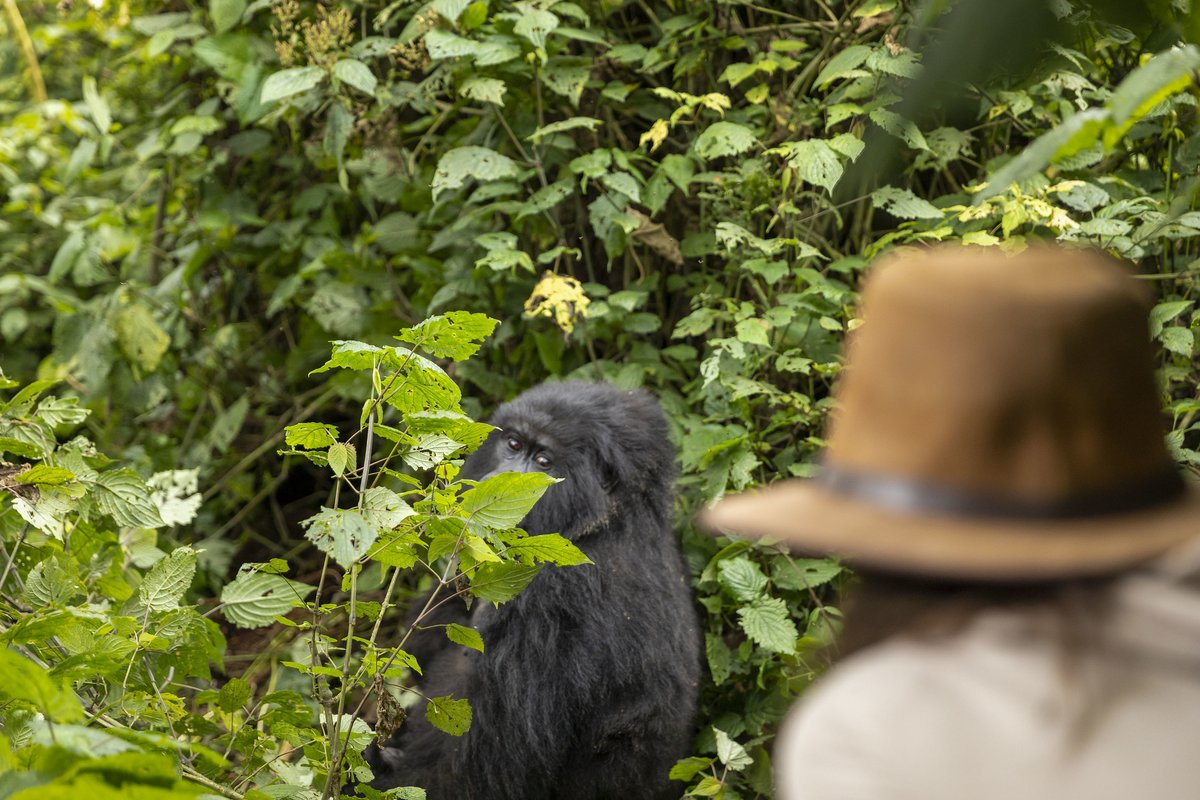
Gorilla Safari Social Structure: Understanding the Family Group
One of the most fascinating parts of a gorilla safari is realizing that you are not simply watching individual animals. You are observing a highly organized family society with leadership, parenting, communication, protection, conflict resolution, and emotional bonds that are surprisingly complex.
Whether trekking in Bwindi Impenetrable National Park, Volcanoes National Park, or Virunga National Park, the real story during a gorilla encounter is often not just the gorillas themselves, but the social relationships inside the family group.
Understanding gorilla social structure changes the trekking experience completely. Instead of seeing random behavior in the forest, visitors begin recognizing leadership roles, family dynamics, parenting behavior, and social communication happening constantly around them.
What a gorilla family group is
Mountain gorillas live in stable social groups often called troops or families. These groups usually stay together for many years and move through the forest as a coordinated unit.
A typical gorilla family includes:
One dominant silverback
Several adult females
Juveniles and infants
Sometimes younger blackback males
In some rare cases, groups may contain more than one silverback, especially if subordinate males remain tolerated within the family structure.
The family operates almost like a tightly connected community where every member has a role and social position.
The silverback: leader and protector
The dominant silverback is the center of the entire gorilla family structure.
A silverback is an adult male gorilla that develops a patch of silver hair across his back as he matures. He is usually the oldest, strongest, and most experienced member of the group.
His responsibilities are extensive.
He leads movement through the forest, decides feeding and resting locations, resolves conflicts, protects the group from danger, and maintains social stability.
During trekking, visitors often notice that other gorillas constantly monitor the silverback’s reactions. His body language influences the emotional atmosphere of the entire family.
If he remains calm, the group usually remains relaxed.
If he becomes tense or defensive, other gorillas quickly react.
How silverbacks protect the family
Silverbacks are famous for protective behavior.
When danger appears-whether another gorilla group, predators, or unfamiliar humans-the silverback positions himself between the threat and the family.
Defensive behavior may include:
Standing upright
Chest-beating
Vocalizations
Ground slapping
Mock charges
These displays are usually intimidation rather than direct aggression. In most habituated gorilla groups, silverbacks remain remarkably tolerant toward tourists as long as visitors follow trekking rules.
Despite their enormous strength, silverbacks are often calm and patient within the family, especially around infants and juveniles.
Adult females in the group
Adult females form the social core of gorilla family life.
They are responsible for raising infants, maintaining social bonds, grooming, and supporting overall group stability.
Unlike some primate societies where females remain in their birth groups permanently, female gorillas may transfer between groups during their lifetime.
Relationships between females are generally peaceful, although competition for silverback attention and preferred resting space can sometimes occur.
Mothers spend years caring for their young because gorilla infants develop slowly and remain highly dependent.
During a gorilla trek, some of the most emotional moments involve mothers holding infants, nursing quietly, or protecting young juveniles during group movement.
Infants and juveniles: the playful side of gorilla society
Young gorillas bring energy and movement to the family group.
Infants remain extremely close to their mothers during the first years of life, often riding on the mother’s chest or back.
As they grow, juveniles become highly playful. Wrestling, climbing, chasing, rolling through vegetation, and mock fighting are all important parts of social development.
These playful interactions help young gorillas develop strength, coordination, social skills, and understanding of group hierarchy.
For tourists, juvenile gorillas are often the most entertaining members of the family because of their curiosity and expressive behavior.
Blackbacks: younger males in transition
Blackbacks are adolescent or young adult male gorillas that have not yet developed the full silver hair of mature silverbacks.
They are physically large and powerful but usually remain subordinate to the dominant silverback.
Some blackbacks stay within the family peacefully, helping protect the group and learning social leadership behavior. Others eventually leave to form their own groups or become solitary males.
Their relationship with the silverback can range from cooperative to competitive depending on age and group dynamics.
How gorillas communicate
Gorilla social life depends heavily on communication.
Communication includes vocal sounds, facial expressions, posture, touch, and movement.
Soft grunts and low vocalizations are commonly used during feeding and peaceful interaction. Louder calls may signal warning, irritation, or group coordination.
Physical contact is also important. Grooming, touching, and close resting positions strengthen social bonds within the family.
Even subtle behaviors carry meaning. A quick glance from the silverback or a mother pulling an infant closer may communicate emotional shifts inside the group.
During trekking, guides often help visitors interpret these social signals.
Group movement and daily life
Gorilla families move together through the forest in search of food, water, and safe resting areas.
Mountain gorillas are primarily herbivorous and spend much of the day feeding on leaves, shoots, stems, roots, and seasonal fruit.
The silverback usually determines when the group moves or rests. Group members rarely wander far from one another because maintaining cohesion is important for protection and social stability.
In the evenings, gorillas build nests from vegetation for sleeping. Infants usually share nests with their mothers.
Daily life may appear calm and repetitive at first glance, but constant social interaction occurs throughout the day.
Conflicts within gorilla groups
Although gorilla groups are generally peaceful, conflicts still occur.
Competition may involve mating access, food space, social dominance, or juvenile behavior.
The silverback usually resolves tension quickly through posture, vocalization, or physical intervention.
Serious fights inside stable habituated groups are relatively uncommon because gorilla society values cohesion and stability.
However, encounters between different gorilla groups can become tense, especially when dominant males compete for females or territory.
Emotional intelligence and family bonds
One reason gorilla trekking feels so emotionally powerful is the visible depth of gorilla social relationships.
Gorillas show affection, patience, grief, playfulness, protectiveness, curiosity, and reassurance in ways that feel strikingly familiar to humans.
Mothers comfort infants.
Juveniles seek attention and approval.
Silverbacks monitor vulnerable members carefully.
Group members rest together peacefully for long periods.
These emotional interactions create the strong psychological connection many travelers experience during trekking.
Why social structure matters for conservation
Understanding gorilla family structure is critical for conservation.
When poaching, disease, or habitat destruction affects a gorilla group, the consequences extend far beyond individual animals. Losing a silverback, mother, or infant can destabilize the entire social system.
Because gorillas reproduce slowly and depend heavily on stable family relationships, protecting group integrity is essential for long-term survival.
Tourism revenue helps fund ranger patrols, veterinary care, scientific monitoring, and habitat protection that support these family groups.
What tourists should observe during trekking
Many first-time visitors focus mainly on taking photographs, but the deeper experience comes from watching interaction rather than just appearance.
Instead of only looking at the silverback, observe:
How mothers interact with infants
How juveniles play together
How the silverback monitors the group
How individuals communicate through touch and posture
How the family stays coordinated while moving
These details reveal the complexity of gorilla society far more than dramatic displays alone.
Thoughts
A gorilla safari is not simply about seeing large primates in the forest. It is about entering the social world of one of humanity’s closest relatives.
Gorilla family groups are organized, emotionally connected societies built around leadership, parenting, protection, and cooperation. Every member of the group contributes to the stability of the family, from the dominant silverback to the youngest infant.
Understanding this social structure transforms gorilla trekking from a wildlife viewing activity into a much deeper experience of observing intelligence, emotion, and family life in the wild.